Benzodiazepine withdrawal syndrome
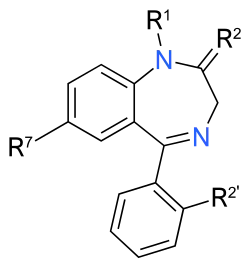

The benzodiazepine withdrawal syndrome refers to set of symptoms that occurs when someone on benzodiazepine suddenly stops taking it.[1]
Symptoms
Those suffering from the benzodiazepine withdrawal syndrome tend to have at least one of the following symptoms:[1]
- Anxiety
- Nausea
- Irritability
- Insomnia
- Headache
- Weight loss
- Muscle pain
- Hand tremor
- Panic attacks
The symptoms can last up to two weeks,[1] or until some treatment is given to the patient.[1] The higher doses of benzodiazepine a patient takes, the more serious the withdrawal symptoms can be if he or she suddenly stops taking it.[1]
Complications
In serious cases, seizures or psychosis can happen,[1] which are life-threatening.[1]
Risk factors
Addiction to alcohol or sedatives is found to make the symptoms worse.[1]

Related pages
References
- 1 2 3 4 5 6 7 8 H Pétursson (1994). "The benzodiazepine withdrawal syndrome". Addiction. 89 (11): 1455‒9. doi:10.1111/j.1360-0443.1994.tb03743.x. PMID 7841856.
- ↑ Soyka M (2017). "Treatment of Benzodiazepine Dependence". The New England Journal of Medicine. 376 (12): 1147–1157. doi:10.1056/NEJMra1611832. PMID 28328330. S2CID 205117734.