Battle of Hussainiwala
| Battle of Hussainiwala | |||||||||
|---|---|---|---|---|---|---|---|---|---|
| Part of Indo-Pakistani War of 1971 | |||||||||
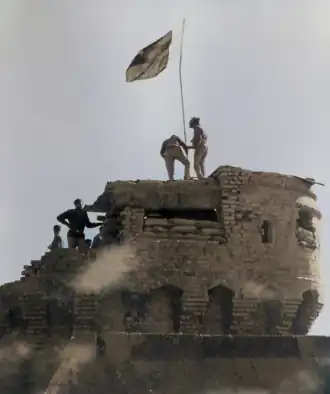 Pakistani troops hoist Pakistani flag at Kasr-e-Hind fortress in Hussainiwala area | |||||||||
| |||||||||
| Belligerents | |||||||||
 India |
 Pakistan | ||||||||
| Commanders and leaders | |||||||||
|
Brig. Pran Anand[3] Lt.
Col T.S Shastry Maj. Kanwalijit Sandhu (POW) Maj. S.P.S Warraich (POW) |
Maj. Gen Majeed Malik Brig. Mohammad Mumtaz Khan Lt. Col Ghulam Hussain Chaudhry Walayat Khan Habib Ahmed Asif Khurshid Afzal | ||||||||
| Units involved | |||||||||
|
| ||||||||
| Casualties and losses | |||||||||
| Heavy losses | 148 casualties | ||||||||
The Battle of Hussainiwala was fought between India and Pakistan in the Hussainiwala enclave as part of the western front of the Indo-Pakistani War of 1971. After fierce fighting, Hussainiwala bluge was captured on 4 December 1971 by the 106th Infantry Brigade of the Pakistani Army, and the defending Indian 15 Punjab unit retreated with heavy losses.[4][5]
Background
The Indian area of Hussainiwala is located west of the Sutlej along the Ferozepur-Lahore highway. It covers about 7.5 hectares and runs in a curved shape from the rail and road bridge towards Shamoke in a northwesterly direction. The countryside is mainly near the river and crossed by with protective banks of earth, important among them being the Ullake, the Hockey Spur, the Perimeter and the Guide. All of them run parallel to the river from southwest to northeast and at right angles to the old railway and road banks.[6]
The importance of this enclave to India is three reasons. Economically, it forms a part of the Hussainiwala headworks send water the Gang Canal system which bring water the dry district of Ganganagar and Karanpur. This role has however been less important now after the construction of the Harike headworks and the Rajasthan feeder. Politically, it is the site of the Shabeed Bhagat Singh memorial. Militarily, the area affords depth to the headworks and the road-rail bridge in defence and provides a readymade starting point across the Sutlej to support offensive operations in developing a thrust towards Kasur and Lahore. In addition, it can also act as a launching pad for a counteroffensive to relieve pressure against formations holding the axes near from Kasur towards Amritsar and the Beas.[6]
Order of battle
Pakistani order of battle
As part of Operation Chengiz Khan, the 11th Infantry Division under Major General Majeed Malik[7] would be responsible for activities in the Kasur District, while the 52 Brigade would be deployed to advance into Khemkaran. The 106 Brigade under the command of Brigadier Mohammad Mumtaz Khan[8] would capture the village of Hussainiwala. The 106 Brigade consisted of the Three Punjab, Nine Punjab, and the 41 Baloch. The 45 Field Regiment Artillery would provide artillery support.[9]
Indian order of battle
During the engagement, responsibility for the sector rested with the 7th Infantry Division of the Indian Army. Within the division, operations were conducted by the 35th Infantry Brigade, which formed the principal combat grouping in the area.[10] The infantry brigade was commanded by Brigadier Pran Anand, a recipient of Vishisht Seva Medal.[11] The brigade’s core infantry component was provided by the 15th Punjab Regiment, supported by the 49th Air Defence Regiment to provide additional support, and the 3rd Cavalry Regiment, which furnished the brigade’s armour and mobile firepower. External support from artillery units were allocated as well.[12][13] To reinforce the defensive layout along the frontier, the Border Security Force (BSF) was also integrated into the order of battle. In this capacity, the 25th and 31st Battalions of the BSF were placed under command, thereby augmenting the brigade’s infantry strength and contributing to the security of key positions.[14][15]
Battle
December 3
At twilight of 3 December, Pakistani 106 Infantry Brigade (11 Division) attacked with two infantry battalions and a troop of armour. The opening barrage of artillery fire completely surprised the Indian 15 Punjab (35 Brigade), a reinforced two-battalion strength unit tasked to defend the enclave.[16] The whole area was extremely well prepared for defence with pill-boxes, concrete emplacements and bunkers. Anti-tank ditches had also been dug in selected tactical places and mines and barbed-wire had been extensively used.[17]
Major General Sukhwant Singh mentioned in his book, India's Wars Since Independence, that the Pakistani operational plan envisaged a three-pronged offensive: the first advancing along the main road axis through the defensive barrier, the second directed southwards towards the bridge at the perimeter-defended locality, and the third launched from the northwestern axis with the objective of overrunning the Border Outposts (BOPs).[18]
The B Company (Three Punjab) ran into minefields planted by the 15 Punjab during their advance but continued on despite heavy enemy fire and succeeded in occupying the mouth of the main bridge.[17] At 6:30 PM, the 41 Baloch crossed the Dipalpur Canal, Major Muhammad Hanif. Waves of Pakistani attacks persisted throughout the night, however halting at the Bhagat Singh Memorial. The Memorial changed hands twice as Major SPS Waraich (Commander of the Indian Barriers at the Memorial) halted the Pakistani advance. Major Ashraf Khan of the 41 Baloch had arrived at the Hussainiwala headwaters after crossing the Dipalpur Canal with heavy casualties, as he cut off Indian resistance along the perimeter of the headwaters. The Four Cavalry arrived as armored support for the 41 Baloch to diminish and capitulate remaining Indian resistance.[19]
December 4
As the morning of the 4 December arrived, the Indian Air Force provided air support with 24 sorties on the positions of the Pakistani soldiers.[20] The Hussainiwala bridge sustained damage with four of its spans being destroyed between the two days.[21][22]
By the night of December 4, the resistance offered by the 15 Punjab was hopeless, as the Pakistanis had secured the Dipalpur Canal and the headwaters, and Hussainiwala was bound to fall. In order to prevent the complete extermination of the 15 Punjab, Lt. Colonel Shastry retreated from Hussainiwala.[23][24]
Aftermath
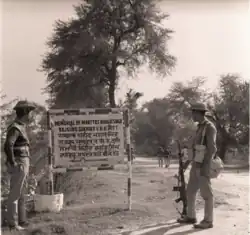
Upon the withdrawal of the 15 Punjab from Hussainiwala,[25] the village fell to the Pakistani Army.[26] The Pakistani Army would withdraw from both Hussainiwala and Kaiser-e-Hind after the end of the war.[27]
Casualties
Pakistan suffered from 148 casualties. The Indian figures are uncertain. Pakistan claims Indian losses were much higher, The Indian official history of the war, without quoting any figures, concedes that "disaster fell upon the defending Indian forces".[28] However, two key officers of the battle, Major Warich and Major Sandhu were reportedly announced missing in action, and nobody knows about them till now.[29][30][31]
Decorations

The personnel of the Pakistan Army were awarded 1 Hilal-i-Jur'at, 5 Sitara-e-Jurat, 6 Tamgha-i-Jurat, and 1 Imtiazi Sanad for their conduct during the Battle of Hussainiwala.[32]
References
- ↑ Rahman, Tariq (2022-06-09). Pakistan's Wars: An Alternative History. Taylor & Francis. pp. 109–110. ISBN 978-1-000-59440-9.
- 1 2 Haider, Imran. "Western theatre of 1971 war". Army Institute of Military History. p. 19.
- ↑ Gill, John H. (2003). An Atlas of the 1971 India - Pakistan War: The Creation of Bangladesh. National Defense University, Near East South Asia Center for Strategic Studies. p. 87.
- ↑ "1971 War: The Battle of Hussainiwala". 2017-01-09. Retrieved 2025-08-19.
- ↑ "Tribute to Hussainiwala battle heroes". The Tribune. Retrieved 2025-08-28.
- 1 2 Singh, Sukhwant (1980). India's Wars Since Independence: Defence of the western border. Vikas. p. 140. ISBN 978-0-7069-1277-7.
- ↑ Siddiqi, Muhammad Ali (2015-02-08). "REVIEW: The Battle of Hussainiwala". DAWN.COM. Retrieved 2025-08-29.
- ↑ "Honouring our brave soldiers". www.thenews.com.pk. 2008-12-09. Retrieved 2025-08-29.
- ↑ Khan, Fazal Muqueem (1973). Pakistan's Crisis in Leadership. National Book Foundation. p. 206. ISBN 978-0-88386-302-2.
- ↑ Sukhwant Singh. India's Wars Since Independence: Defence of the Western Front. Internet Archive. Advent Books. p. 142. ISBN 978-0-7069-1277-7.
- ↑ Shorey, Anil (2005). A legendary force, 1st Patiala : 300 years of 15 Punjab (Patiala). Internet Archive. New Delhi : Manas Publications. p. 160. ISBN 978-81-7049-246-7.
{{cite book}}: CS1 maint: publisher location (link) - ↑ "Chapter IX - (THE PUNJAB AND RAJASTHAN FRONT)" (PDF). Bharat Rakhshak: 379.
- ↑ Sukhwant Singh. India's Wars Since Independence: Defence of the Western Front. Internet Archive. Advent Books. p. 143. ISBN 978-0-7069-1277-7.
- ↑ Khan, Fazal Muqueem (1973). Pakistan's Crisis in Leadership. National Book Foundation. p. 206. ISBN 978-0-88386-302-2.
- ↑ Gill, John H. (2003). An Atlas of the 1971 India - Pakistan War: The Creation of Bangladesh. National Defense University, Near East South Asia Center for Strategic Studies. p. 87.
- ↑ Tufail, Kaiser (2020). Against All Odds: The Pakistan Air Force in the 1971 Indo-Pakistan War. Helion and Company. p. 55. ISBN 978-1913118648.
- 1 2 Khan, Fazal Muqueem (1973). Pakistan's Crisis in Leadership. National Book Foundation. p. 205. ISBN 978-0-88386-302-2.
- ↑ Singh, Sukhwant (1981). India's Wars Since Independence: Defence of the western border. Vikas Publishing House. p. 142.
- ↑ Ahmed, Habib (2015). The battle of Hussainiwala and Qaiser-i-Hind: the 1971 war (1 ed.). Karachi: Oxford University Press. ISBN 978-0-19-906472-4.
- ↑ Sukhwant Singh. India's Wars Since Independence: Defence of the Western Front. Internet Archive. Advent Books. p. 144. ISBN 978-0-7069-1277-7.
- ↑ "New Hussainiwala bridge, 47 yrs later". The Tribune. Retrieved 2025-08-29.
- ↑ "Defence Minister Inaugurates Hussainiwala Bridge Blown Up During 1971 War". www.ndtv.com. Archived from the original on 2025-06-13. Retrieved 2025-08-29.
- ↑ Sukhwant Singh. India's Wars Since Independence: Defence of the Western Front. Internet Archive. Advent Books. p. 147. ISBN 978-0-7069-1277-7.
- ↑ Air Commodore Kaiser Tufail (Retired) (2020-07-15). Against All Odds The Pakistan Air Force In The 1971 Indo Pakistan War. p. 55.
- ↑ Sukhwant Singh. India's Wars Since Independence: Defence of the Western Front. Internet Archive. Advent Books. p. 147. ISBN 978-0-7069-1277-7.
- ↑ Gill, John H. (2003). An Atlas of the 1971 India - Pakistan War: The Creation of Bangladesh. National Defense University, Near East South Asia Center for Strategic Studies. pp. 53–54.
- ↑ Saikia, Yasmin (2017-07-03). "The Battle of Hussainiwala and Qaiser-i-Hind: The 1971 War". Journal of Military History. 81 (3): 932–934.
- ↑ Rahman, Tariq (2022-06-09). Pakistan's Wars: An Alternative History. Taylor & Francis. p. 110. ISBN 978-1-000-59440-9.
- ↑ "40 years after war, bridge opens near Hussainiwala border". The Times of India. 2013-12-05. ISSN 0971-8257. Retrieved 2025-08-29.
- ↑ Shorey, Anil (2005). A legendary force, 1st Patiala : 300 years of 15 Punjab (Patiala). Internet Archive. New Delhi : Manas Publications. p. 168. ISBN 978-81-7049-246-7.
{{cite book}}: CS1 maint: publisher location (link) - ↑ "1971 India-Pakistan war: The silent screams of those missing in action". Firstpost. 2021-12-14. Retrieved 2025-08-29.
- ↑ "The Battle of Hussainiwala". BOL News. Archived from the original on 2025-09-08. Retrieved 2025-08-28.
- Ahmed, Habib (2015). The battle of Hussainiwala and Qaiser-i-Hind: the 1971 war (1. ed.). Karachi: Oxford University Press. ISBN 978-0-1990-6472-4. Retrieved August 28, 2025.
- Rahman, Tariq (2022). "The 1971 War: The Pakistani Experience". Pakistan's wars: an alternative history. Abingdon, Oxon ; New York: Routledge. doi:10.4324/9781003254645. ISBN 9781003254645. Retrieved 29 August 2025.
- Saikia, Yasmin (July 1, 2017). "The Battle of Hussainiwala and Qaiser-i-Hind: The 1971 War". Journal of Military History: 932–934. (review of Ahmed Habib's book)