Attacks on civilians in the Russian invasion of Ukraine
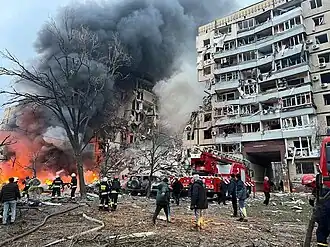
During the Russian invasion of Ukraine, the Russian military have, many times, intentionally attacked civilian targets[1][2] and indiscriminate attacks in densely populated areas. The United Nations Human Rights Monitoring Mission in Ukraine says the Russian military has caused civilians to suffer unneeded and disproportionate harm by using cluster bombs[3][4] and by firing other weapons with which effect a wide area into civilian areas, such as missiles, heavy artillery shells. As of 2025, the attacks had resulted in the UN recording the deaths of between 14,000[5] and estimated 40,000 innocent civilians.[6] On 22 April 2022, the UN reported that of the 2,343 civilian injuries and deaths it had been able to document, it could confirm 92.3% of those civilians where killed by Russians.[7]
On 5 July 2022, the UN High Commissioner for Human Rights (OHCHR), Michelle Bachelet, reported that most of the civilians whose injury or death because of the war that had documented by her office had been killed or injured by the Russian army's use of explosive weapons with a big area of effect in areas in which people lived, calling it "indisputable". By 30 June 2023, OHCHR assessed that 90.5% of all civilian deaths were caused by these attack, and that 84.2% of them were recorded in territory controlled by the Ukrainians.[8] The Spanish newspaper El País estimated that by March 2023 the Russians were firing at a rate of between 600,000 and 1.8 million shells per month.[9] By February 2024, Russia had fired between 12 and 17 million artillery shells against Ukraine.[10] By the end of 2023, Russian forces launched about 7,400 missiles and 3,900 Shahed drone strikes against Ukraine according to Ukrainian military officials.[11]
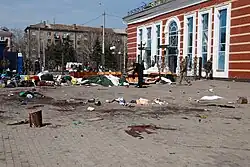
Reports on the use of cluster bombs raised worries about the big number of civilian casualties and the long-lasting danger of unexploded bombs.[4] According to the OHCHR, cluster bombs have been used by Russian armed forces and pro-Russian rebels in areas with lots of people, resulting in civilian injuries or deaths.[12]
References
- ↑ "Chernihiv: Are these Russia's weapons of war?". BBC News. 9 April 2022. Archived from the original on 3 May 2022. Retrieved 3 May 2022.
- ↑ Gall, Carlotta; Kramer, Andrew E. (3 April 2022). "In a Kyiv Suburb,'They Shot Everyone They Saw'". The New York Times. ISSN 0362-4331. Archived from the original on 12 April 2022. Retrieved 3 May 2022.
- ↑ "United Nations Treaty Collection". Archived from the original on 22 March 2022. Retrieved 11 April 2022.
- 1 2 Lance, Rachel. "The Enduring Danger of Cluster Bombs". Wired. ISSN 1059-1028. Archived from the original on 8 April 2022. Retrieved 2 April 2022.
- ↑ "Number of civilian casualties in Ukraine during Russia's invasion verified by OHCHR from February 24, 2022". Statista.
- ↑ Carl Conetta (2 May 2023). "Catastrophe: The Global Cost of the Ukraine War" (PDF). Project on Defense Alternatives. pp. 1–2.
- ↑ "UN's Bachelet condemns 'horrors' faced by Ukraine's civilians". UN News. 22 April 2022. Archived from the original on 24 April 2022. Retrieved 24 April 2022.
- ↑ "Ukraine: Civilian casualties - 24 February 2022 to 30 June 2023". OHCHR. 7 July 2023. Retrieved 11 July 2023.
- ↑ María R. Sahuquillo (1 March 2023). "Ukraine outgunned 10 to 1 in massive artillery battle with Russia". El País. Retrieved 10 April 2023.
- ↑ "Russian military industry". Estonian Defence Ministry. 2024.
- ↑ "RUSSIAN OFFENSIVE CAMPAIGN ASSESSMENT, DECEMBER 28, 2023". Institute for the Study of War. 28 December 2023. Archived from the original on 8 June 2024. Retrieved 30 December 2023.
- ↑ "The situation of human rights in Ukraine in the context of the armed attack by the Russian Federation, 24 February to 15 May 2022". OHCHR. Retrieved 2025-09-21.