Athelbald of Wessex
| Athelbald | |
|---|---|
| King of Wessex | |
 | |
| Reign | 856/858 - 20 December 860 |
| Born | 834[1] |
| Died | 20 December 860 |
| Burial | |
| Spouse | Judith |
| Father | Athelwulf |
| Mother | Osburga |
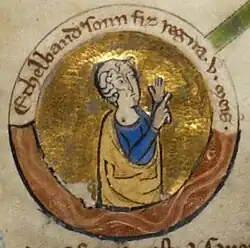
Athelbald, also spelled Æthelbald or Ethelbald (c. 834–860) was a West Saxon nobleman. In 856 he was King of Wessex while his father was in Rome. When Athelwulf returned, Athelbald refused to step down. To avoid a civil war, Athelwulf gave his son the kingdom of Wessex and became sub-king of Kent.
Career
Athelbald was the second of the five sons of King Athelwulf of Wessex and Osburga.[2] She was the daughter of Oslac, Athelwulf's butler.[a][4] He was born about 832. He is recording fighting alongside his father in 851 in the battle at Acleah.[5] There the Vikings who had just defeated Berhtwulf of Mercia near London and when they moved into Surrey they were met and defeated by the West Saxons.[5] In 855 his father Athelwulf went on a pilgrimage to Rome.[6] He left the kingdom in the care of Athelbald.[6] After spending a year in Rome and spending time at court of Charles the Bald, King of the West Franks, Athelwulf returned. But he had wed the king's young daughter, Judith.[6] She could not have been any older than thirteen at the time.[6] The Frankish king Charles had insisted that his daughter be consecrated queen.[b][8] When Athelwulf returned to Wessex with his new Queen, Athelbald objected to his father remaining king. To avoid a civil war Athelwulf agreed to take the sub-kingship of Kent. He let Ethelbald retain his position as king of Wessex.[6] Athelwulf died in 858 as the King of Kent.[9] Athelbald then took his father's young wife Judith as his own wife, apparently without a major scandal.[6]
Despite his marriage to his step-mother Judith, he had no children. He was succeeded by his brother Athelbert of Wessex.[10]
Notes
- ↑ The office of chief butler in an Anglo-Saxon royal household is most likely his title here. He would be a nobleman who held the honorary office of butler.[3]
- ↑ Charles wanted his daughter's position safeguarded in England. Up to this time in Wessex they did not allow queens. The king's wife was just that, the king's wife.[7] In Wessex there were old superstitions regarding the evil of having a queen.[7] But his new wife was accepted by his people.[7]
References
- ↑ https://www.findagrave.com/memorial/3379/ethelbald
- ↑ Detlev Schwennicke, Europäische Stammtafeln: Stammtafeln zur Geschichte der Europäischen Staaten, Neue Folge, Band II (Marburg, Germany: J. A. Stargardt, 1984), Tafel 78
- ↑ Laurence Marcellus Larson, The King's Household in England Before the Norman Conquest, Thesis (Ph. D.), University of Wisconsin (1902), p. 127
- ↑ Asser's Life of King Alfred, Trans. L.C. Jane (London: Chatto & Windus, 1926), p. 3
- 1 2 Jim Bradbury, The Routledge Companion to Medieval Warfare (London; New York: Routledge, 2004), p. 141
- 1 2 3 4 5 6 Frank Stenton, Anglo-Saxon England (Oxford University Press, 1971), p. 245
- 1 2 3 Asser's Life of King Alfred, trans. L.C. Jane (London: Chatto and Windus, 1908), p. 10
- ↑ Jennifer Ward, Women in England in the Middle Ages (London: Continuum International Publishing Group, 2006), p. 120
- ↑ Mike Ashley, The Mammoth Book of British Kings and Queens (New york: Carroll & Graf, 1999), p. 317
- ↑ Barbara Yorke, Kings and Kingship in Early Anglo-Saxon England (London: Seaby, 1990. ISBN 0-415-16639-X, pp. 148–158 & p. 133, table 15. Barbara Yorke, Kings and Kingship in Early Anglo-Saxon England (London: Seaby, 1990), p. 148
Other websites
- Britannia: Kings of Wessex Archived 2013-07-27 at the Wayback Machine