Ascension of Jesus
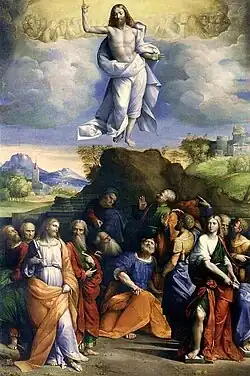
According to the New Testament, the Ascension of Jesus happened at the end of Jesus' life on earth. The Acts of the Apostles says that after Jesus told his apostles to teach the gospel to everyone, he went up to heaven to be with God.[1]The Apostles' Creed says that Jesus "ascended into heaven and is seated at the right hand of God the Father". There He is praying for those who believe in Him. [2]
The Ascension is detailed in both the Gospel of Luke and the Acts of the Apostles:
Then he led them out to the vicinity of Bethany, and lifting up his hands he blessed them. And while he was blessing them, he left them and was carried up into heaven. After worshiping him, they returned to Jerusalem with great joy. And they were continually in the temple praising God.
— Luke, 24:50–24:53, [3]
Then they gathered around him and asked him, “Lord, are you at this time going to restore the kingdom to Israel?” He said to them: “It is not for you to know the times or dates the Father has set by his own authority. But you will receive power when the Holy Spirit comes on you; and you will be my witnesses in Jerusalem, and in all Judea and Samaria, and to the ends of the earth.” After he said this, he was taken up before their very eyes, and a cloud hid him from their sight. They were looking intently up into the sky as he was going, when suddenly two men dressed in white stood beside them. “Men of Galilee,” they said, “why do you stand here looking into the sky? This same Jesus, who has been taken from you into heaven, will come back in the same way you have seen him go into heaven.”
— Acts, 1:6-1:11, [4]
Ascension Day is often celebrated on a Thursday, the fortieth day of Easter, although some Christian denominations have moved the observance to the following Sunday.
The Ascension of Jesus is included in the Glorious Mysteries of the Saint Rosary.
References