Anomaloglossus stepheni
| Anomaloglossus stepheni | |
|---|---|
 | |
Scientific classification  | |
| Kingdom: | Animalia |
| Phylum: | Chordata |
| Class: | Amphibia |
| Order: | Anura |
| Family: | Aromobatidae |
| Genus: | Anomaloglossus |
| Species: | A. stepheni |
| Binomial name | |
| Anomaloglossus stepheni (Martins, 1989) | |
| Synonyms[2] | |
| |
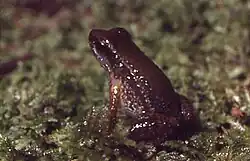
Stephen's rocket frog (Anomaloglossus stepheni) is a frog. It lives in Pará and Amazonas in Brazil and in Suriname.[2][3][1]
Body
The adult male frog is 14-17 mm long from nose to rear end and the adult female frog was 16-18 mm long. The skin of the frog's back is more than one brown. There is a darn brown stripe from the nose to the middle of the body. There are blue-white dots under it and on the toes. The male frog's voice sac is white or gray in color. Young frogs have dark heads and light brown backs.[3]
Home
These frogs are awake during the day.[3] These frogs live on the dead leaves on the ground in forests that have never been cut down and forests that are growing back.[1]
This species lives in the leaf-litter of old growth and secondary tropical rainforest. It lays its eggs on land, and tadpoles are nidicolous[1]
Scientists have seen this frog inside protected places: Área de Proteção Ambiental de Presidente Figueiredo - Caverna do Moroaga, Floresta Nacional de Saraca-Taquera, Floresta de Faro, Reserva Biológica de Uatuma, Reserva Biológica do Rio Trombetas, Reserva Florestal Adolpho Ducke, and Reserva Extrativitsa Riozinho do Anfrisio.[1]
Food
Adult frogs eat termites, flies, and beetles. Young frogs eat collembolans and mites.[3]
Young
The frogs have young between November and March. The female frog lays eggs on the sides of rolled leaves. She lays 3-6 eggs at a time. The tadpoles grow in nests on land. The male frog watches the eggs and tadpoles.[3][1]
Danger
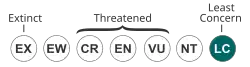
Scientists say this frog is not in danger of dying out. The forests are large.[1]
References
- 1 2 3 4 5 6 7 IUCN SSC Amphibian Specialist Group (2023). "Stephen's Rocket Frog: Aromobates stepheni". IUCN Red List of Threatened Species. 2023: e.T55151A133806205. doi:10.2305/IUCN.UK.2023-1.RLTS.T55151A133806205.en. Retrieved April 2, 2025.
- 1 2 Frost, Darrel R. "Anomaloglossus stepheni (Martins, 1989)". Amphibian Species of the World, an Online Reference. Version 6.0. American Museum of Natural History, New York. Retrieved April 2, 2025.
- 1 2 3 4 5 Albertina P. Lima; William E. Magnusson; Marcelo Menin; Luciana K. Erdtmann; Domingos J. Rodrigues; Claudia Keller; Walter Hödl (November 14, 2007). Kellie Whittaker (ed.). "Anomaloglossus stepheni (Martins, 1989)". AmphibiaWeb. University of California, Berkeley. Retrieved April 2, 2025.