American Civil War casualties
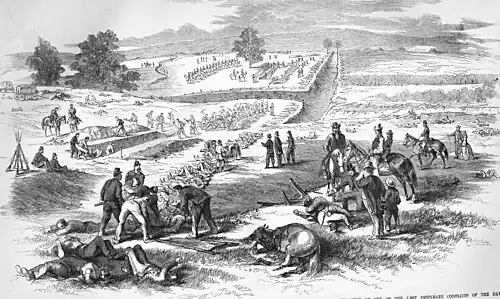
American Civil War casualties are the Union and Confederate soldiers who became unable to perform their duties for any reason (like disease, injury, going missing, being captured, or death).[1][2]
A single soldier could be listed as a casualty several times during the war, which makes it impossible to know exactly how many people were casualties.[1]
Based on digitized nineteenth-century census data, there were around 750,000 deaths during the Civil War.[3] This is not the number of casualties in the war - only the number of deaths. Disease caused around 3 out of every 4 of these deaths.[4]
Background
The American Civil War was the nation's bloodiest war.[1] The violence in battles such as Shiloh, Antietam, Stones River and Gettysburg shocked everyone in the country, both North and South.[1] It also shocked international observers.[1]
Beginnings
Before the war, in 1860, no one expected any armed conflict would happen after the Southern states seceded from the Union.[5] If there was conflict, people expected it to be brief and mostly for show purposes.[5] Southerners did not believe the North would mobilize an army against them. The U.S. Senator from South Carolina declared he would drink all the blood shed over the South for declaring their independence from the Union.[5]
Then, as it became clear that there would be a military confrontation, both sides believed it would not last very long.[5] In 1861, when the Union Army entered the First Battle of Bull Run, they thought a quick victory would end the war.[5] Meanwhile, after the Confederate forces won the battle, they thought the Union would simply give up the idea of re-uniting the North and South.[5] Both were wrong.[5]
Weapons & tactics
During the 1850s there were a number of improvements in weapons, especially rifles.[6] During the Civil War, both armies had rifles that could shoot farther, could reload faster, and were much more accurate than the muskets used in the Mexican–American War.[6] Yet both sides were using the same military tactics as the earlier war: close formations of men firing in volleys.[6] The new rifles combined with obsolete tactics were responsible for up to 90% of all deaths in battle.[6]
The good death
Mid-nineteenth century attitudes towards death and dying for a noble cause contributed to the Civil War. At the time, many men saw war as a chance for glory and honor.[5] They thought that dying for their country, or for a noble cause, was the most important thing they could ever do - the highest calling.[5] Dying of disease was considered a horrible way to die, though, and most feared it more than dying in battle.[5]
War was presented to soldiers as a way to die "for God and country".[5] This represented both Christian and nationalist beliefs about going to war. As most of the soldiers were Christians, they were far better prepared to die than to kill.[5]
American society in general, and soldiers in particular, believed in the ars moriendi (the art of dying) or the "good death." These attitudes left soldiers to believe that a good death was glorious and at the same time a last act of redemption.[7] Also, by dying well, a person showed others how to die well.[7]
Death estimates
The exact number of dead will never be known with any certainty. All Civil War casualty numbers are estimates, no matter what the source. For over a hundred years, most historians have accepted the total number of dead as 618,222, generally rounded off to 620,000.[8] Newer estimates have put the number at about 750,000 (about 20% higher than previous estimates).[9]
Poor records
As many as half of the men killed in Civil War battles were not identified when they were buried.[9] The records kept by each company were designed to keep track of how many men were in each unit, not to keep track of each soldier.[9] Confederate military records are even fewer than Union records.
When Richmond fell in 1865, records were destroyed, shipped south or left behind.[10] Some of the records were kept by the Union Army and sent to the War Department in Washington, D.C.. The Adjutant General started a bureau for the “collection, safekeeping, and publication of Rebel Archives” in July of 1865.[10] In 1903, the Secretary of War asked Southern Governors to lend the War Department any Confederate Army records they had so they could be copied.[10]
Early death estimates

Since about 1900, historians have quoted the numbers produced by Thomas L. Livermore: 618,222 total Confederate and Union deaths during the war.[11] However, Livermore's number was based on incomplete battle reports, and it made a crude guess as to how many soldiers died from disease and other causes.[9] His book was titled Numbers and Losses in the Civil War in America, 1861-65.[3]
There were some earlier estimates that were calculated in different ways. The superintendent of the 1870 United States Census, Francis A. Walker, estimated the number of male Civil War deaths to be “not less than 850,000.”[11] But this was not as widely accepted as later, lower estimates.[11] This was partly because the census itself that year was suspected of being wrong.[11] To get his estimate, Walker calculated how much the United States' population should have grown during the Civil War. (This population growth rate had been consistent during the nineteenth century.) Then he subtracted the number of males who were missing from the census.[11]
In the 1880s, Civil War veteran William F. Fox compiled an estimate the hard way.[3] He went over every muster list, battlefield record and pension record he could find.[3] In 1889 he wrote Regimental Losses in the American Civil War, 1861-1865. He estimated that 94,000 soldiers had died in the war.[3] Fox also contributed information on the average Union soldier (for example, that he averaged 5 feet 8 ¼ inches tall and weighed 143 ½ pounds).[3]
Livermore's figure of 618,222 total deaths became widely accepted. (The number of casualties was much greater; Livermore was only calculating deaths.)
Modern death estimate
Some historians believe the earlier death estimates were probably far too low.[3] A demographic historian from New York's Binghamton University, J. David Hacker, has made a new calculation of Civil War deaths: 750,000. This is about 20% higher than Livermore thought.[3] Hacker based his estimate on digitized nineteenth-century census data.[3]
The 1860 population of the United States was just under 31.5 million. Approximately 2,000,000 men served in the Union forces, while about 750,000 served in the Confederacy.[12] About 75% of soldiers were born in America.[12] Of the remaining 25% who were foreign-born, many did not appear in any census records prior to the Civil War.[3] These factors make it impossible to know exactly how many casualties there were during the war.
Civil War-era medicine
Civil War-era medicine actually contributed to the war's high death tolls.[13] At times, treatment of wounds, infections and diseases actually did more harm than good.[13][14][15]
Even healthcare practitioners were not immune; nurses were particularly at risk of catching diseases from the soldiers they tended.[15]

Lack of knowledge
In 1861, medical knowledge, diagnostic procedures, equipment, and treatment protocols were very crude by modern standards. The germ theory of disease was not widely accepted.[4] Doctors often did not understand disease causes, and medical hygiene was so poor that it killed patients.[4]
In many cases, doctors could do little to treat their patients, or even hastened their deaths by failing to wash their hands and instruments before moving from one patient to the next. These simple protocols did not begin to take hold until later in the war through the pioneering military medical management efforts of William A. Hammond and Jonathan Letterman.
Poor hygiene
Military camp hygiene was extremely poor.[14] Inadequate sanitation facilities, contaminated water, and the lack of shelter, clothing, shoes and food[a] all contributed to high death rates in the camps.[15]
Diarrhea and dysentery became the leading causes of death. Casualty figures showed that roughly twice as many soldiers died from disease as from the most frequent type of battle injury - the gunshot wound (shown in Latin terminology on military medical records as Vulnus Sclopet).[14][17][18][19] Over 40% of hospitalized soldiers died from hospital gangrene throughout most of the war.[4]
Common medical problems
Based on military records, Civil War soldiers often suffered from these ailments:[14][19]
- Brain, heart, kidney, and respiratory conditions (including asthma, Bright's Disease, bronchitis, heart disease, heatstroke/sunstroke, nephritis, and pleurisy)
- Skin conditions (army itch, dermatitis, erysipelas, insect stings and bites)
- Digestive complaints and other illnesses arising from poor food or water quality (constipation, scurvy)
- Infectious diseases (abscesses, cholera, conjunctivitis, consumption/tuberculosis, diphtheria, malarial/intermittent fevers, measles, pneumonia, scarlet fever, smallpox/variola, syphilis and other venereal diseases, tetanus, typhoid fever, typhus fever, unidentified viral infections, yellow fever)
- Musculoskeletal injuries (broken bones, dislocations, rheumatism, sprains)
- Parasites
Prisoners of war
Soldiers who were captured by the enemy and held as prisoners of war (POWs) were even more at risk. In many cases, they were housed in such miserable conditions that they faced a higher likelihood of catching and dying from a disease.[14] Starvation also became a problem in POW camps as more soldiers were captured in battle and food shortages worsened.[14][18][20]
Amputations

The most common surgery
Amputation was by far the most common surgery in the Civil War.[21] Around 60,000 surgeries were done during the war, according to estimates.[22] Of these, nearly 75% were amputations.[22]
There were several reasons for this. Bullet wounds made by the slow-moving Minié ball caused major damage.[21] They often shattered bones beyond repair.[21]
Another reason was to prevent gangrene and other complications.[22] Men often lay unattended for a day or more before being brought to a surgeon.[21] Perhaps the most important reason was that medics had too many wounded men and very little time to reconstruct damaged body parts.[23]
Lastly, if a man was wounded in the head, stomach or chest, he rarely lived long enough to be taken to a field hospital.[24]

"Butchers"
Until the war, most American doctors had never seen wounds like these.[23] Most only had experience in lancing boils or pulling teeth.[23] Doctors knew very little about germs and bacteria. They used bandages over and over again on different men without washing or disinfecting them first.[23] By modern standards their operations were crude, even brutal.
Soldiers called medics "butchers" and feared amputations more than anything else. To avoid losing a limb and the painful operation, some soldiers and officers tried to treat their wounds themselves.[22]
Wound location
A soldier's ability to survive after an amputation depended partly on where his wound was.[21] The closer a wound was to the center of the body, the higher the mortality rate.[21]
For example, Confederate General John Bell Hood was wounded in the leg at the Battle of Chickamauga. His leg was amputated just over 4 inches (100 mm) from his hip. This type of hip operation had an 83% mortality rate.[21] Hood was among the 17% who survived.
By comparison, arm wounds had a much lower mortality rate: 24%.[21] But Stonewall Jackson did not survive long after the loss of his arm.
Process
Surgeons completed the amputation process quickly.[24] They had to, in order to keep the patient from losing too much blood or going into shock.[24] A leg amputation at the knee could be done in three minutes.[24] In most cases, some form of anesthesia was used.[21]
The surgery started with cutting around the arm or leg. Then the surgeon would saw through the bone. They would pull out the soldier's nerves as far as possible, then cut them off.[24]
They often left the bloody stump to heal by itself; other time, they sewed a flap of skin over the stump.[24]
After the amputation
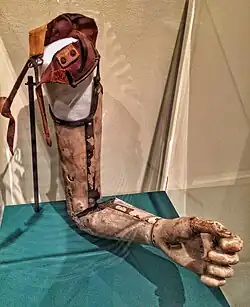
Men who survived an amputation needed to return to their work after the war.[23] Each of them needed a prosthesis to replace their missing arm or leg.[23]
North Carolina was the first of the former Confederate states to provide artificial legs to its veterans who needed them.[23] They passed a law in 1866 that promised this.[23] Any veteran amputee who could not use an artificial leg received $70.[23] In total, North Carolina took care of 1,550 veterans who applied for help.[23]
Notes
- ↑ Civil war soldiers on both sides had a very simple diet.[16] Food could not be preserved with refrigeration or by canning, as both were later inventions.[16] Soldiers ate hardtack (hard biscuits made with flour, water and salt), salted pork, bacon and occasionally beef preserved with potassium nitrate .[16] However, hardtack was the most common food. It was cheap, easy to store and ship to the troops.[16] However it could and did break soldier's teeth and often contained worms.[16] During the trench warfare at the Siege of Petersburg, officers continually had to tell soldiers to keep the trenches clean and not throw their hardtack in the trenches.[16] A soldier famously replied: “We’ve thrown it out two or three times, sir, but it crawls back”.[16]
References
- 1 2 3 4 5 "Civil War Casualties". Civil War Trust. Retrieved 10 September 2016.
- ↑ American Civil War: The Definitive Encyclopedia and Document Collection , eds. Spencer Tucker; James R Arnold; Roberta Wiener; et al. (Santa Barbara, CA: ABC-CLIO, LLC, 2013), p. 317
- 1 2 3 4 5 6 7 8 9 10 Guy Gugliotta (2 April 2012). "New Estimate Raises Civil War Death Toll". Science. The New York Times. Retrieved 10 September 2016.
- 1 2 3 4 Price, David (2020-10-08). ""The Direct and Logical Consequence" - Germ Theory and the Civil War". National Museum of Civil War Medicine. Retrieved 2025-10-08.
- 1 2 3 4 5 6 7 8 9 10 11 12 Drew Gilpin Faust, This Republic of Suffering: Death and the American Civil War (New York: Vintage Books, 2009), pp. 3–6
- 1 2 3 4 Patrick Rael, Eighty-eight Years: The Long Death of Slavery in the United States, 1777-1865 (Athens, GA: The University of Georgia Press, 2015), p. 257
- 1 2 Mark S. Schantz, Awaiting the Heavenly Country: The Civil War and America's Culture of Death (Ithaca, NY: Cornell University Press, 2008), pp. 18–19
- ↑ "Civil War Casualties". AmericanCivilWarStory.com. Retrieved 10 September 2016.
- 1 2 3 4 Rachel Coker (21 September 2011). "Historian revises estimate of Civil War dead". Discover-e. Binghamton University, The State University of New York. Retrieved 10 September 2016.
- 1 2 3 "Confederate Military Records". Civil War Soldier Search. Archived from the original on 8 September 2016. Retrieved 10 September 2016.
- 1 2 3 4 5 J. David Hacker (20 September 2011). "Recounting the Dead". The New York Times. Retrieved 10 September 2016.
- 1 2 "Casualties and Costs of the Civil War". The Gilder Lehrman Institute of American History. Retrieved 11 September 2016.
- 1 2 "Civil War Medicine". Civil War Trust. Retrieved 10 September 2016.
- 1 2 3 4 5 6 "Civil War Medicine". Son of the South. Retrieved 10 September 2016.
- 1 2 3 "Civil War Diseases". Civil War Academy. Archived from the original on 8 December 2016. Retrieved 10 September 2016.
- 1 2 3 4 5 6 7 "What Did Civil War Soldiers Eat?" (PDF). Civil War Trust. Retrieved 10 September 2016.
- ↑ Snyder, Laurie. Medical, in 47th Pennsylvania Volunteers: One Civil War Regiment's Story. Retrieved online, 1 August 2017.
- 1 2 Registers of Deaths of Volunteers, in Records of the U.S. Adjutant General's Office (Record Group 94). Washington, D.C.: U.S. National Archives and Records Administration, 1861-1865.
- 1 2 Sharp, Rebecca. Medical and Surgical History of the War of the Rebellion (video). Washington, D.C.: U.S. National Archives and Records Administration, 3 June 2015.
- ↑ Roll of Honor (No. XIV): Names of Soldiers Who, in Defence [sic] of the American Union, Suffered Martyrdom in the Prison Pens throughout the South, in Quartermaster General's Office, General Orders No. 7, February 20, 1868. Washington, D.C.: Government Printing Office, 1868.
- 1 2 3 4 5 6 7 8 9 "Civil War Battlefield Surgery". eHistory. The Ohio State University. Retrieved 11 September 2016.
- 1 2 3 4 "Maimed Men". U.S. National Library of Medicine. Retrieved 11 September 2016.
- 1 2 3 4 5 6 7 8 9 10 Ansley Herring Wegner. "Amputations in the Civil War". NCpedia. State Library of North Carolina. Retrieved 11 September 2016.
- 1 2 3 4 5 6 Terry L Jones (17 November 2012). "Under the Knife". The New York Times. Retrieved 11 September 2016.