Amadeo Bordiga
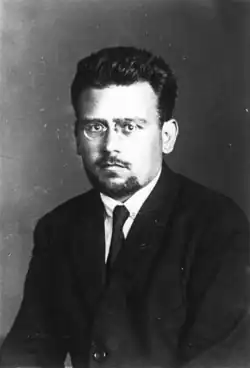
Amadeo Bordiga (13 June 1889 – 23 July 1970) was an Italian Marxist. He helped make the Communist Party of Italy (PCdI). He is recognized as a significant figure in the Italian Left Communist tradition. Many groups later called Bordigists followed ideas based on his work.
Early life
Bordiga was born in Resina, near Naples, Italy. He studied engineering and became involved in socialist politics at a young age. He joined the Italian Socialist Party (PSI) and became part of its left wing.
Role in the Communist Party of Italy
After World War I, Bordiga helped create the Communist Party of Italy in 1921. He supported a strict and disciplined party that did not take part in elections or alliances with other parties.
In 1924 he became a member of the Executive Committee of the Communist International (Comintern).
Bordiga often disagreed with other communist leaders, such as Joseph Stalin. By the late 1920s he was removed from leadership and later expelled from the party as it became controlled by Stalinists.
Opposition to fascism
Under Benito Mussolini’s fascist government, Bordiga was arrested several times. He spent many years under police watch but continued to write and discuss politics privately.
Later work and ideas
After World War II, Bordiga returned to political activity. He helped guide the International Communist Party, although he did not take public roles or titles.
He taught that the communist program should remain unchanged and based firmly on the ideas of Marx and Engels. He believed that the working class needed a strong and unified party to prepare for revolution, and that the party should not change its principles to gain popularity.
Bordiga also argued that the Soviet Union was not socialist but a form of state capitalism, because it kept wage labor, markets, and a ruling bureaucracy. He described communism as a future society without money, without the market, and without the state, where production would be organized directly by the community.
Death
Amadeo Bordiga died on July 23, 1970, in Formia, Italy.
Legacy
Bordiga is seen as one of the main theorists of the Italian Left Communist movement. Several small political groups in Europe and elsewhere continue to follow his ideas, sometimes called Bordigism. His writings remain influential among Marxist thinkers who criticize both capitalism and the model of socialism used in the Soviet Union.