Allobates kingsburyi
| Allobates kingsburyi | |
|---|---|
Scientific classification  | |
| Kingdom: | Animalia |
| Phylum: | Chordata |
| Class: | Amphibia |
| Order: | Anura |
| Family: | Aromobatidae |
| Genus: | Allobates |
| Species: | A. kingsburyi |
| Binomial name | |
| Allobates kingsburyi (Boulenger, 1918) | |
| Synonyms[2] | |
| |
Kingbury's rocket frog (Allobates kingsburyi) is a species of frog that lives in Ecuador.[2][3][1]
Description
The adult male frog is 16.3–20.3 mm long from nose to rear end and the adult female frog is 18.8–22.2 mm long.
The skin of the frog's back is brown with a cream-colored line down each side of the body. The sides of the body are black and the eardrum is brown. There is a cream-yellow line on each side of the body from the eye to the mouth.
The tops of the front legs are brown with small lines. The tops of the back legs are also brown, but have darker marks. On the belly, the male frog has dark marks, but the female does not. The iris of the eye is black with some gold.[3]
Frogs that are not adults yet have wider stripes than adults do.[3]
Name
G.A. Boulenger named this frog after an assistant who was killed in Palestine in 1918.[3]
Home
This frog lives on the dead leaves on the ground in forests that have never been cut down and in forests that were destroyed and are growing back. Scientists saw the frog from 1,140–1,300 m (3,740–4,270 ft) meters above sea level.[2][1]
Some of the places this frog lives are protected parks: Parque Nacional Sangay, Parque Nacional Podocarpus, Parque Nacional Llanganates, and Parque Nacional Cayambe Coca.[1]
Young
Scientists think the female frog lays her eggs on the ground and that the males carry the tadpoles to streams after the eggs hatch.[1]
Danger
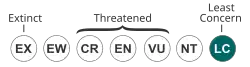
Scientists say this frog is in danger of dying out. They think the frogs might even all be dead now.
The frog's natural environment has shrunk because people destroy its habitat to make farms, to make places for animals to eat grass, and to get wood to build with.[1]
References
- 1 2 3 4 5 6 IUCN SSC Amphibian Specialist Group (2023). "Kingsbury's Rocket Frog: Allobates kingsburyi". IUCN Red List of Threatened Species. 2023: e.T55100A98645478. doi:10.2305/IUCN.UK.2023-1.RLTS.T55100A98645478.en. Retrieved December 19, 2024.
- 1 2 3 Frost, Darrel R. "Allobates ranoides (Boulenger, 1918)". Amphibian Species of the World, an Online Reference. Version 6.0. American Museum of Natural History, New York. Retrieved December 19, 2024.
- 1 2 3 4 Luis A. Coloma; Nadia Páez-Rosales; Caty Frenkel; Cristina Félix-Novoa; Alexandra Quiguango-Ubillús (December 18, 2017). Santiago R. Ron (ed.). "Allobates kingsburyi (Boulenger, 1918)". AmphibiaWeb (in Spanish). University of California, Berkeley. Retrieved December 19, 2024.