Algerian Civil War
| Algerian Civil War | ||||||||
|---|---|---|---|---|---|---|---|---|
 | ||||||||
| Belligerents | ||||||||
|
 Islamic Salvation Front Supported by:  Libya[2] (until 1995)  Iran[3] (alleged)  Morocco[3][5] (alleged) |
| ||||||
| Commanders and leaders | ||||||||
 Ali Kafi Liamine Zéroual Abdelaziz Bouteflika Mohamed Lamari Mohamed Mediène |
Ali Belhadj Abdelkader Hachani |
 Antar Zouabri † | ||||||
| Strength | ||||||||
|
|
| Unknown | ||||||
| Casualties and losses | ||||||||
| Most civilian casualties were estimated from 60,000 to 150,000 | ||||||||



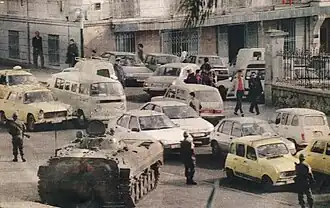
The civil war in Algeria (1992–2002) was an internal armed conflict in Algeria which began in 1992 and ended in 2002. In this war, the country's government, founded after a coup d'état, faced Islamic militias/rebels.
Why it happened
In the late 1990s, President of Algeria Chadli Bendjedid began a process of reforming the nation, which was already binded by the one-party system, led by the National Liberation Front, to a multi-party system.
The first round of the 1991 Algerian parliamentary election had shown the strong rising movement of Muslim groups, especially the Islamic Salvation Front.
On 11 January 1992, the election results were cancelled, some military generals (janviéristes) began a coup d'état, forcing Bendjedid to resign. The country's leadership was given to a military dictatorship led by Mohamed Boudiaf and another government body led by Prime Minister Sid Ahmed Ghozali. By declaring national emergency, the government suspended constitutional rights: every protest was surpressed in blood; many international organisation like Amnesty International, had reported human rights violations systematically and regular tortures.
After the Islamic Salvation Front's dissolution, according to an official order on 4 March, many Islamic groups created the terrorist Armed Islamic Group (al-Jamāʿa al-Islāmiyya al-Musallaḥa). The group's military action led to the hijacking event of Air France Flight 8969 at Houari Boumediene Airport in 1994 and the systemic murder of thousands of civilians.
President Boudiaf, who was assassinated on 29 June 1992, was succeeded by Ali Kafi.
References
- ↑ Rex Brynen, Bahgat Korany, Paul Noble (1995). Political Liberalization and Democratization in the Arab World. 1. Lynne Rienner Publishers. p. 289. ISBN 978-1-55587-579-4.
- 1 2 3 4 Sidaoui, Riadh (2009). "Islamic Politics and the Military: Algeria 1962–2008". In Jan-Erik Lane, Hamadi Redissi, Riyāḍ Ṣaydāwī. Religion and Politics: Islam and Muslim Civilization. Ashgate. pp. 241–243. ISBN 978-0-7546-7418-4.
- 1 2 3 4 Karl DeRouen, Jr., Uk Heo (2007). Civil Wars of the World: Major Conflicts Since World War II. ABC-CLIO. pp. 115–117. ISBN 978-1-85109-919-1.
- ↑ Arms trade in practice, Hrw.org, October 2000
- ↑ Yahia H. Zoubir, Haizam Amirah-Fernández (2008). North Africa: Politics, Region, and the Limits of Transformation. Routledge. p. 184. ISBN 978-1-134-08740-2.
- ↑ Aaron Mannes (2004). Rowman & Littlefield (ed.). Profiles in Terror: The Guide to Middle East Terrorist Organizations. p. 8. ISBN 978-0-7425-3525-1.