Al-Burda
| Part of a series on |
| Muhammad Arabic: محمد |
|---|
 |
Qasida e-Burda (Arabic: قَصِيدَةُ الْبُرْدَةِ, "Ode of the Mantle"), or al-Burda for short, is a poem from a long time ago. It talks about Muhammad and how wonderful he is. Al-Busiri, a scholar from Egypt, wrote it. The full name is "The Celestial Lights in Praise of the Best of Creation" (Arabic: الْكَوَاكِبُ الدُّرِّيَّةُ فِي مَدْحِ خَيْرِ الْبَرِيَّةِ, romanized: al-Kawākib al-durriyya fī Madḥ Khayr al-Bariyya).
The poem is loved by many Muslims. It tells that al-Busiri was sick. He loved Muhammad very much. One night, Muhammad came in a dream and gave him a mantle (cloak). When al-Busiri woke up, he was well again.[1][2]
Before this, Ka'b ibn Zuhayr wrote a poem called Al-Burda (also called Bānat Suʿād). He showed it to Muhammad after he became Muslim. Muhammad liked it and put his cloak on Ka'b. But the poem by al-Busiri became more famous, even though Muhammad had really wrapped Ka'b, not in a dream.
Composition
The Burda has ten chapters and 160 verses. All verses rhyme. A line is repeated many times:
"My Lord, send blessings and peace always on Your Beloved, the Best of All Creation" (Arabic: مولاي صل وسلم دائما أبدا على حبيبك خير الخلق كلهم).
Each verse ends with the Arabic letter mīm. This is called mīmiyya. The ten chapters are:
- On love
- On warnings about the self
- On praise of Muhammad
- On his birth
- On his miracles
- On the high status and wonders of the Qur'an
- On Muhammad going to heaven
- On Muhammad’s struggles
- On asking for help through Muhammad
- On talking to God and asking for wishes
Popularity
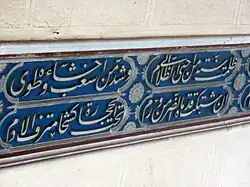
Many Sufis love this poem. People memorize it, say it together, and put it on walls in mosques and buildings. It decorated Prophet's Mosque in Medina for many years, but now only two lines are left.[3]
More than 90 books explain it. Timothy Winter made an English version.[4] It is also in Hausa, Persian, Urdu, Turkish, Berber languages, Punjabi, French, German, Sindhi, Saraiki, Norwegian, Chinese (called Tianfangshijing), and more.
Many Sunni Muslims say it every day or on special days like Mawlid. It is one of the most said poems in the world.
Legacy
The Burda is important in Sufi Islam. Many Sufi teachers wrote about it,[5] like Ibn Hajar al-Haytami,[6] Nazifi,[6] and Qastallani.[7]
Shafi'i scholar Ibn Hajar al-Asqalani (d. 852 A.H.) read it with his teacher and from copies of al-Busiri.[8]
Al-Burda gave ideas to Ahmad Shawqi for his poem Nahj al-Burda.
Related pages
- Al-Busiri
- Salawat
- Islamic poetry
References
- ↑ "Anthology of Arabic Poems about the Prophet and the Faith of Islam Containing the Famous Poem of Al-Busaree". Archived from the original on 2009-12-10. Retrieved 2009-11-11.
- ↑ "The poem of the scarf by Shaikh Faizullah Bhai B. A. – University of Bombay – Published by Taj Company Ltd". Archived from the original on 2009-12-10. Retrieved 2009-11-11.
- ↑ "BBC – Religions – Islam: al-Burda". Retrieved 2016-12-17.
{{cite web}}: line feed character in|title=at position 4 (help) - ↑ "Imam al-Busiri, The Mantle Adorned", Timothy Winter (Abdal Hakim Murad), (London: Quilliam Press, 2009)
- ↑ Meri, Josef W. (2005-10-31). Medieval Islamic Civilization: An Encyclopedia. Routledge. p. 166. ISBN 978-1-135-45596-5.
{{cite book}}: line feed character in|title=at position 9 (help) - 1 2 Krätli, Graziano; Lydon, Ghislaine (2011-01-01). The Trans-Saharan Book Trade: Manuscript Culture, Arabic Literacy and Intellectual History in Muslim Africa. BRILL. p. 126. ISBN 978-90-04-18742-9.
{{cite book}}: line feed character in|title=at position 4 (help) - ↑ Lewis, B.; Menage, V.L.; Pellat, Ch.; Schacht, J. (1997) [1st. pub. 1978]. Encyclopaedia of Islam. Vol. IV (Iran-Kha) (New ed.). Leiden, Netherlands: Brill. p. 737. ISBN 90-04-07819-3.
- ↑ Sobieroj, Florian (2016-05-24). Variance in Arabic Manuscripts: Arabic Didactic Poems from the Eleventh to the Seventeenth Centuries – Analysis of Textual Variance and Its Control in the Manuscripts. Walter de Gruyter GmbH & Co KG. p. 65. ISBN 978-3-11-046000-1.
{{cite book}}: line feed character in|title=at position 9 (help)
Bibliography
- Blair, Sheila S.; Bloom, Jonathan M. (1995). The Art and Architecture of Islam. 1250 - 1800. Yale University Press. ISBN 978-0-300-05888-8.
- James, David (1983). The Arab Book. Chester Beatty Library.