African swine fever virus
| African swine fever virus | |
|---|---|
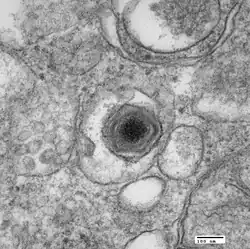 | |
| Electron micrograph of a virus particle | |
Virus classification  | |
| (unranked): | Virus |
| Realm: | incertae sedis |
| Kingdom: | incertae sedis |
| Phylum: | incertae sedis |
| Class: | incertae sedis |
| Order: | incertae sedis |
| Family: | Asfarviridae |
| Genus: | Asfivirus |
| Species: | Asfivirus haemorrhagiae |
The African swine fever virus (ASFV) is a very contagious virus that infects domestic pigs and wild boars. It causes a severe disease called African swine fever (ASF), which often leads to death. ASFV is a large DNA virus that belongs to the family Asfarviridae and the genus Asfivirus. The virus does not cause disease in humans.
Spread and hosts
ASFV mainly spreads through direct contact between pigs, through contaminated pork products, and through soft ticks of the genus Ornithodoros. These ticks can carry the virus for a long time and help it spread between animals. ASFV can persist in its natural hosts such as warthogs, bushpigs, and wild pigs without causing signs of disease.
Survival in the environment
ASFV is very tough and can survive for months or even years in pork products, and it can remain in the environment for long periods. This makes controlling the disease difficult once it appears in an area. Strict biosecurity and hygiene measures are essential to prevent its spread.
Signs and symptoms
In pigs, ASF can cause high fever, loss of appetite, depression, abnormal breathing, coughing, and discoloration of the skin. In newborn piglets, it may cause congenital tremors. Pigs may die within days after infection, and pregnant sows may experience spontaneous abortions. Less severe infections cause weight loss, pneumonia, skin ulcers, and swollen joints.
Diagnosis
ASF is similar to classical swine fever, so laboratory tests are necessary for diagnosis. Tests include ELISA, PCR, and virus isolation from blood, lymph nodes, spleen, or serum of infected pigs.
Virology
ASFV is a large icosahedral DNA virus with a linear genome of about 189 kilobases. It contains over 180 genes that help the virus replicate and survive. ASFV infects mainly monocytes and macrophages, and it replicates in perinuclear virus factories inside the cell. The virus also encodes proteins that prevent cell death and inhibit immune responses, helping it spread efficiently.
Genotypes and evolution
There are 22 genotypes of ASFV identified based on the p72 protein gene. ASFV likely evolved from a virus in soft ticks that infect wild swine. It first appeared around the 1700s in Africa. The virus has spread over time to Europe, Asia, and the Caribbean due to pig trade and movement of infected animals or products.
Vaccine research
There is no fully approved vaccine yet, but experimental vaccines have been developed. Vietnam successfully produced a vaccine in 2022, and other experimental vaccines are in development in the United States. These vaccines show promise in protecting pigs from ASFV infection.
History
The first recognized outbreak of ASF occurred in 1907 in Kenya. It remained in Africa until 1957, when it spread to Portugal and later to Spain and France. ASF has caused outbreaks in many countries worldwide, including Cuba, Russia, Ukraine, Belarus, the Baltic states, Italy, Germany, and others. The virus continues to spread through wild boars and pig trade, causing major economic losses to the pig industry.