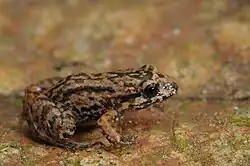
Adenomera thomei
| Adenomera thomei | |
|---|---|
 | |
Scientific classification  | |
| Kingdom: | Animalia |
| Phylum: | Chordata |
| Class: | Amphibia |
| Order: | Anura |
| Family: | Leptodactylidae |
| Genus: | Adenomera |
| Species: | A. thomei |
| Binomial name | |
| Adenomera thomei (Almeida and Angulo, 2006) | |
| Synonyms[2] | |
| |
Home
This frog lives in Atlantic forests. People also see it in small pieces of forest. They see it on sandy ground and on the dead leaves on the ground. They have also seen it in places that human beings have changed, for example next to cacao farms. Scientists have seen this frog between 0 and 100 m (0 and 328 ft) meters above sea level.[1]
Scientists have seen these frogs in protected places, for example APA Lagoa Encantada and Refúgio de Vida Silvestre Municipal das Serras de Marica.[1]
Young
The male frog sits on the dead leaves on the ground and calls to the female frogs. This frog puts eggs in a nest made out of bubbles on very wet ground and in pools where the water does not move.[1]
Danger
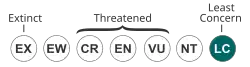
Scientists from the IUCN say this frog is not in danger of dying out.[1]
First paper
- Almeida Angulo (2006). "A new species of Leptodactylus (Anura: Leptodactylidae) from the state of Espirito Santo, Brazil, with remarks on the systematics of associated populations". Zootaxa. 1334: 1–25. doi:10.11646/zootaxa.1334.1.1. Retrieved February 2, 2026.
References
- 1 2 3 4 5 6 IUCN SSC Amphibian Specialist Group; Instituto Boitatá de Etnobiologia e Conservação da Fauna (2023). "Adenomera thomei". IUCN Red List of Threatened Species. 2023: e.T136182A172239740. doi:10.2305/IUCN.UK.2023-1.RLTS.T136182A172239740.en. Retrieved February 2, 2026.
- 1 2 Frost, Darrel R. "Adenomera thomei (Almeida and Angulo, 2006)". Amphibian Species of the World, an Online Reference. Version 6.0. American Museum of Natural History, New York. Retrieved February 2, 2026.
- ↑ "Adenomera thomei(Almeida & Angulo, 2006)". AmphibiaWeb. University of California, Berkeley. Retrieved February 2, 2026.