Adenomera martinezi
| Adenomera martinezi | |
|---|---|
Scientific classification  | |
| Kingdom: | Animalia |
| Phylum: | Chordata |
| Class: | Amphibia |
| Order: | Anura |
| Family: | Leptodactylidae |
| Genus: | Adenomera |
| Species: | A. martinezi |
| Binomial name | |
| Adenomera martinezi (Bokermann, 1956) | |
| Synonyms[2] | |
| |
Martinez's tropical bullfrog (Adenomera martinezi) is a frog. It lives in Brazil.[2][3][1]
Home
This frog lives in grassy places near rocks. Scientists have seen it 440 m (1,440 ft) meters above sea level.[1]
Scientists have not seen these frogs in protected places, but they saw it near Reserva Biológica Nascentes Serra do Cachimbo and on an air force base.[1]
Young
The male frog sits on the grass or in a hole underground and calls to the female frogs. The tadpoles swim in fields that flood for part of the year.[1]
Danger
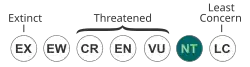
Scientists from the IUCN say this frog is in a little danger of dying out. It does not live in a protected park, but it does live on an air force base where human beings do not change the plants or ground. In other places, human beings set fires to control the grass. Scientists do not know if this frog is good at living in places that human beings have changed.[1]
References
- 1 2 3 4 5 6 IUCN SSC Amphibian Specialist Group (2022). "Adenomera martinezi". IUCN Red List of Threatened Species. 2022: e.T77639796A86256039. doi:10.2305/IUCN.UK.2022-2.RLTS.T77639796A86256039.en. Retrieved January 29, 2026.
- 1 2 Frost, Darrel R. "Adenomera martinezi (Bokermann, 1956)". Amphibian Species of the World, an Online Reference. Version 6.0. American Museum of Natural History, New York. Retrieved January 29, 2026.
- ↑ "Adenomera martinezi (Bokermann, 1956)". AmphibiaWeb. University of California, Berkeley. Retrieved January 29, 2026.