Adenomera kweti
| Adenomera kweti | |
|---|---|
Scientific classification  | |
| Kingdom: | Animalia |
| Phylum: | Chordata |
| Class: | Amphibia |
| Order: | Anura |
| Family: | Leptodactylidae |
| Genus: | Adenomera |
| Species: | A. kweti |
| Binomial name | |
| Adenomera kweti Carvalho, Cassini, Taucce, and Haddad, 2019 | |
Kwet's nest-building frog (Adenomera kweti) is a frog. It lives in Brazil.[2][3][1]
Home
This frog only lives in forests, Atlantic rainforests.[4] People see it on the dead leaves on the ground. Scientists have seen it between 0 and 1,070 m (0 and 3,510 ft) above sea level.[1]
Scientists have seen these frogs in protected places, for example Parque Estadual da Serra do Tabuleiro and Parque Natural Municipal do Maciço da Costeira.[1]
Young
The male frog sits under dead bamboo leaves and calls to the female frogs. Scientists believe this frog puts its eggs in nests made out of bubbles. Scientists think the tadpoles grow in the nest.[1]
Danger
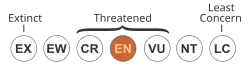
Scientists from the IUCN say this frog is in big danger of dying out. Human beings cut down forests to make towns, farms, tree farms, places for animals to eat grass, and places to dig sandstone out of the ground.[1]
References
- 1 2 3 4 5 6 IUCN SSC Amphibian Specialist Group; Instituto Boitatá de Etnobiologia e Conservação da Fauna (2023). "Adenomera kweti". IUCN Red List of Threatened Species. 2023: e.T152359110A152359135. doi:10.2305/IUCN.UK.2023-1.RLTS.T152359110A152359135.en. Retrieved February 13, 2026.
- ↑ Frost, Darrel R. "Adenomera kweti Carvalho, Cassini, Taucce, and Haddad, 2019". Amphibian Species of the World, an Online Reference. Version 6.0. American Museum of Natural History, New York. Retrieved February 13, 2026.
- ↑ "Adenomera kweti Carvalho, Cassini, Taucce, & Haddad, 2019". AmphibiaWeb. University of California, Berkeley. Retrieved February 13, 2026.
- ↑ de Carvalho TR; CS Cassini; PPG Taucce; CFB Haddad (2019). "A new, morphologically cryptic species of Adenomera closely related to Adenomera araucaria from the Atlantic Forest of southern Brazil (Anura, Leptodactylidae)". Journal of Herpetology (Abstract). 53: 131–143. doi:10.1670/18-172. Retrieved February 13, 2026.