Adenomera hylaedactyla
| Adenomera hylaedactyla | |
|---|---|
 | |
Scientific classification  | |
| Kingdom: | Animalia |
| Phylum: | Chordata |
| Class: | Amphibia |
| Order: | Anura |
| Family: | Leptodactylidae |
| Genus: | Adenomera |
| Species: | A. hylaedactyla |
| Binomial name | |
| Adenomera hylaedactyla (Cope, 1868) | |
| Synonyms[2] | |
| |
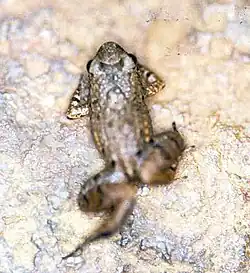
The dark-spotted thin-toed frog, Napo tropical bullfrog, or rana dedilarga de manchas oscuras (Adenomera hylaedactyla) is a frog. It lives in Bolivia, Colombia, Ecuador, Brazil, French Guiana, Guyana, Peru, Suriname, Paraguay, Trinidad and Tobago, and Venezuela.[2][3][1]
Body
This frog is small. The adult male frog is 22-24 mm long from nose to rear end and the adult female frog is 26-27 mm. The skin of the frog's back is brown in color with many dark marks. There are two folds of skin on each side of the body. The belly and throat are white in color. The lower parts and fronts of the back legs are yellowish in color. The iris of the eye is bronze in color.[3]
Home
This frog lives on the ground in places without many trees, for example next to rivers and on farms. Mostly, it lives in or near forests that have never been cut down and forests that are growing back. Scientists have seen it between 0 and 1,000 m (0 and 3,281 ft) meters above sea level.[1]
Scientists have seen these frogs in protected places.[1]
Young
The female frog puts her eggs in a nest made out of bubbles in a hole underground. The tadpoles grow into frogs in the nest. They do not eat food. The bag of yolk on their bodies is their only food.[3][1]
Danger
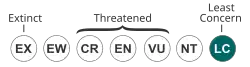
Scientists from the IUCN say this frog is not some danger of dying out. It is good at living in places that human beings have changed.[1]
References
- 1 2 3 4 5 6 IUCN SSC Amphibian Specialist Group (2023). "Dark-spotted Thin-toed Frog Adenomera hylaedactyla". IUCN Red List of Threatened Species. 2023: e.T56309A85857530. doi:10.2305/IUCN.UK.2023-1.RLTS.T56309A85857530.en. Retrieved January 26, 2026.
- 1 2 Frost, Darrel R. "Adenomera hylaedactyla Cope, 1868". Amphibian Species of the World, an Online Reference. Version 6.0. American Museum of Natural History, New York. Retrieved January 26, 2026.
- 1 2 3 Albertina P. Lima; William E. Magnusson; Marcelo Menin; Luciana K. Erdtmann; Domingos J. Rodrigues; Claudia Keller; Walter Hödl (December 5, 2007). Kellie Whittaker; Michelle S. Koo (eds.). "Adenomera hylaedactyla Cope, 1868". AmphibiaWeb. University of California, Berkeley. Retrieved January 26, 2026.