Adenomera aurantiaca
| Adenomera aurantiaca | |
|---|---|
Scientific classification  | |
| Kingdom: | Animalia |
| Phylum: | Chordata |
| Class: | Amphibia |
| Order: | Anura |
| Family: | Leptodactylidae |
| Genus: | Adenomera |
| Species: | A. aurantiaca |
| Binomial name | |
| Adenomera aurantiaca Carvalho, Moraes, Lima, Fouquet, Peloso, Pavan, Drummond, Rodrigues, Giaretta, Gordo, Neckel-Oliveira, and Haddad, 2021 | |
The orange-legged terrestrial nest-building frog (Adenomera aurantiaca) is a frog. It lives in Brazil.[2][3][1]
Home
This frog lives in rainforests not far above sea level. It only lives in rainforests that do not flood. Scientists have seen it between 78 and 102 m (256 and 335 ft) above sea level.[1]
Scientists have seen these frogs in a protected place, Floresta Nacional de Itaituba II, next to the Rio Jamanxim.[1]
Danger
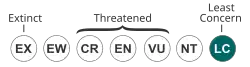
Scientists from the IUCN say this frog is not in danger of dying out. But some of the frogs live near a town called Trairão, which is growing bigger. People also build small farms near the towns.[1]
First paper
- Carvalho, TR de; Moraes LJCL; Lima AP; Fouquet PA; Peloso PLV; Pavan D; Drummond L de O; Rodrigues MT; Giaretta AA; Gordo M; Neckel-Oliveira S; Haddad CFB (2021). "Systematics and historical biogeography of Neotropical foam-nesting frogs of the Adenomera heyeri clade (Leptodactylidae), with the description of six new Amazonian species". Zoological Journal of the Linnean Society (Abstract). 191 (2): 395–433. doi:10.1093/zoolinnean/zlaa051. Retrieved February 16, 2026.
References
- 1 2 3 4 5 IUCN SSC Amphibian Specialist Group (2023). "Orange-legged Terrestrial Nest-building Frog: Adenomera aurantiaca". IUCN Red List of Threatened Species. 2023: e.T195582528A195582589. doi:10.2305/IUCN.UK.2023-1.RLTS.T195582528A195582589.en. Retrieved February 25, 2026.
- ↑ Frost, Darrel R. "Adenomera aurantiaca Carvalho, Moraes, Lima, Fouquet, Peloso, Pavan, Drummond, Rodrigues, Giaretta, Gordo, Neckel-Oliveira, and Haddad, 2021". Amphibian Species of the World, an Online Reference. Version 6.0. American Museum of Natural History, New York. Retrieved February 25, 2026.
- ↑ "Adenomera aurantiaca Carvalho, Moraes, Lima, Fouquet, Peloso, Pavan, Drummond, Rodrigues, Giaretta, Gordo, Neckel-Oliveira, & Haddad, 2021". AmphibiaWeb. University of California, Berkeley. Retrieved February 25, 2026.