Acrylonitrile
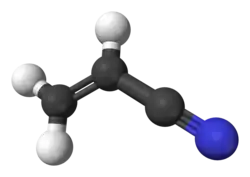
Acrylonitrile is a chemical compound with the chemical formula CH3CHCN. It is a molecule of ethylene where one of the hydrogen atoms has been replaced with the nitrile functional group, −C≡N. Similar to many other substituted ethylenes, it is a monomer used in some types of plastic.
Charles Moureu was the first person to make acrylonitrile. He made it in 1893.[1]
Uses
The main use of acrylonitrile is in acrylonitrile butadiene styrene, also named ABS plastic. This three-part polymer (terpolymer) is made from the three chemicals in its name: acrylonitrile, butadiene, and styrene.[2]
References
- ↑
- Moureu, C. (1893). "Contribution à l'étude de l'acide acrylique et de ses dérivés" [Contribution to the study of acrylic acid and of its derivatives]. Annales de chimie et de physique. 7th. 2: 145–212. See especially pp. 187–189 ("Nitrile acrylique ou cyanure de vinyle (Propène-nitrile)").
- Moureu, C. (1893). "Nitrile acrylique, cyanure de vinyle (propène-nitrile)" [Acrylic nitrile, vinyl cyanide (propenenitrile)]. Bulletin de la Société Chimique de France. 3rd. 9: 424–427.
- ↑ Campo, E. Alfredo (2008-01-01), Campo, E. Alfredo (ed.), "1 - Polymeric Materials and Properties", Selection of Polymeric Materials, Plastics Design Library, Norwich, NY: William Andrew Publishing, pp. 1–39, doi:10.1016/b978-081551551-7.50003-6, ISBN 978-0-8155-1551-7, retrieved May 24, 2026