541132 Leleākūhonua
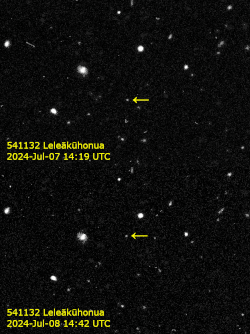 Pictures of Leleākūhonua taken in 2024 | |
| Discovery | |
|---|---|
| Discovered by | David Tholen Chad Trujillo Scott Sheppard |
| Discovery site | Mauna Kea Observatory |
| Discovery date | October 13, 2015 |
| Designations | |
| MPC designation | (541132) Leleākūhonua |
| TNO, Sednoid | |
| Orbital characteristics | |
| Aphelion | 2106 AU |
| Perihelion | 65.16 AU |
| Eccentricity | 0.93997±0.00636 |
| Inclination | 11.654° |
| June 11 2078 | |
| Physical characteristics | |
Mean radius | 110 km |
541132 Leleākūhouna (temporary label 2015 TG387) is a trans-Neptunian object. It has an orbit that is farther than the dwarf planet Sedna from the Sun. American astronomers David Tholen, Chad Trujillo and Scott Sheppard discovered it in October 13, 2015 at the Mauna Kea Observatory.[1] It is around 220 km in diameter. Leleākūhonua takes roughly 32,000 years to orbit the Sun, much higher than Sedna and other trans-Neptunian objects.[2] It is one of the most distant known objects in the Solar System. Leleākūhonua's surface temperature never rises above -240°C.
The name "Leleākūhonua" comes from the Hawaiian word " Leleākūhonua" which means "It flies until land appears" in English.
References
- ↑ "(541132) Leleakuhonua = 2015 TG387". www.minorplanetcenter.net. Retrieved 2026-05-17.
- ↑ "Hawaiian name given to dwarf planet orbiting Sun". University of Hawai'i News. 2020-11-16. Retrieved 2026-05-17.