2025–2026 Iranian protests
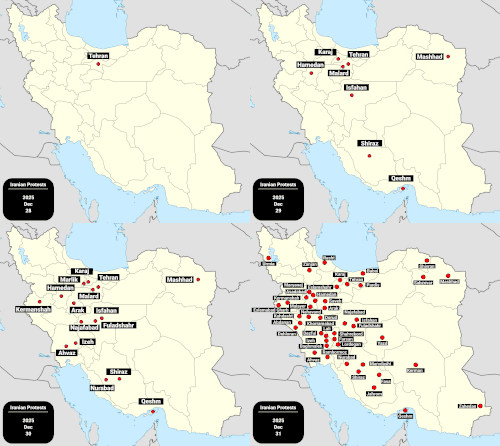
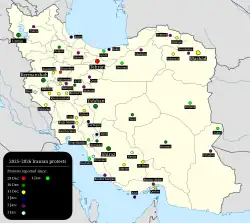
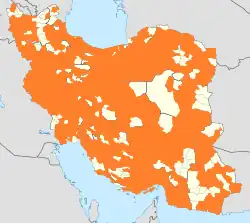
Mass protests erupted in several cities in Iran at the end of December 2025. The protests continued into 2026. Human rights groups and news organizations reported that many people were killed or arrested during the government crackdown. The exact number of deaths is disputed.[1]
The protests were triggered by growing inflation, rising food prices, shortages linked to sanctions placed on Iran by other countries and also mismanagement of the government. The falling value of the Iranian rial also led to more protests.[2] The protests first started in Tehran, the capital city of Iran, and then spread to other major cities across the country.
Over time, the unrest went beyond dissatisfaction with the economy, with protesters calling for an end to the Islamic Republic and ruling of Iran's Supreme Leader Ayatollah Ali Khamenei.[3] Media reports described the protests as the biggest in Iran since the nationwide protests of 2022 after the death of Mahsa Amini.[2]
Timeline
Phase 1 - The Spark (28 - 31 December 2025)
The protest started on 28 December 2025 with shopkeepers and merchants ( known as the bazaaris)[4] going on strike and closing their shops in Tehran's Grand Bazaar.[5] The Bazaaris have played a central role in past revolutions. They are one of the 3 groups that define Iranian social life next to the Intelligentsia, the clerics. [6]
For centuries, these traditional marketplaces have functioned as more than just commercial hubs, also as political meeting places where different people from the community come together. The Grand Bazaar is more than 100 hectares big (147 football/soccer fields big) and 10 plus kilometers long and holds tens of thousands of shops selling everything from clothes, food, services and gold. It is a symbol of Tehran's old economy and dates back to the 17th century, during the Safavid period.
On the 29th of December the head of the Central Bank of Iran, Mohammad Reza Farzin resigned as the protests spread to other cities. On the 30th December the protest spread to even more cities as well as several university campuses,[5] leading students and other parts of the middle class to join.[7]
The end of the first phase was concluded with the widespread closures of almost 70% of the 31 Iranian provinces.[8] In these first 4 days the level of violence from the government and its Islamic Revolutionary Guard against the protesters to stop them also got more significant. By firing live tear gas at protesters and arresting them.[9]
Phase 2 - Escalation (1 - 7 January 2026)
On January 1st the first official fatalities were reported. Dozens of arrests were made by the Islamic Revolutionary Guard, who were also firing live ammunition at protestors. This was later confirmed by several news sources because during phase 2 the internet was also shut down across the country.[10]
On the 2nd of January U.S. President Donald Trump reacted to violence happening during the protest, posting on his own social media platform, Truth Social. "If Iran shots [sic] and violently kills peaceful protesters, which is their custom, the United States of America will come to their rescue".[5][11]
On January 3rd the Supreme Leader Ayatollah Ali Khamenei states: "rioters must be put in their place" which led to more aggressive actions by the security forces on the protesters.[12][5] Which leads to the security forces to begin more aggressive actions against protestors. The protest have now expanded to 25 out of the 31 provinces in Iran. On the 6th of January Human Rights Activists News Agency (HRANA) a us-based organisation states that the death toll has now risen to 36.[5] Which now leads the demonstrations into a new phase:
Phase 3 - The Massacres (8 - 11 January 2026)
On the 8-9th of January the death toll rises into the thousands. Making it one of the deadliest periods in the history of the current Iranian government.[1] The exact number of deaths is very difficult to track because of the internet shutdown.[13] The internet was shut down following a call by exiled Crown Prince Reza Pahlavi for mass demonstrations at 8 p.m. on the 8th and 9th of January. People went to the streets and shouted: “Death to the Islamic Republic!” and “Death to the dictator!” or people called for the return of Pahlavi. Pahlavi also called on U.S. President Donald Trump and several European leaders to demand accountability from the regime.[14]
According to Amnesty International access to internet and telecommunications was cut in an effort to hide state violence. The blackout severely hampers the ability of victims, journalists, and rights groups to document abuses and gather evidence, while state-affiliated media and officials retain full internet access and continue spreading propaganda design to intimidate the public.[1]
Broad internet shutdowns of this kind serve a dual purpose: they conceal human rights abuses while simultaneously constituting violations in their own right, given that internet access is considered a fundamental right.
This tactic is not new for Iran. During protests in November 2019, a near-total communications blackout was imposed while hundreds of protesters and bystanders were unlawfully killed over five days. A similar disruption occurred during the Woman, Life, Freedom movement in 2022. The current shutdown, however, is de longest the authorities have ever imposed.[1]
Phase 4 - Aftermath & Information Control (Mid January)
In the aftermath of the mass killings, thousands more protesters were arrested and a nighttime curfew was imposed in major cities, as heavily armed security forces patrolled the streets.[15][16] According to multiple sources on the ground, residents were ordered not to leave their homes after 8:00PM, the Iranian Regime had imposed 'martial law'.[16] Due to these measures the protest was briefly contained.[15]
Also in the aftermath footage began to emerge of a makeshift morgue at the Legal Medicine Organisation in Kahrizak, near Tehran. This was set up because the facility had gotten overwhelmed by the sheer amount of causalities.[17] Amnesty International analysed five videos from the site and identified at least 205 distinct body bags. With further video showing a digital counter of the deceased reaching 250. [13]
BBC Persian published a report on instagram of the events on the 13th of January, quoting an eyewitness account in Kahrizak: “They [victims’ families] reached an autopsy hall where bodies were piled on top of each other… There was one room that was so full of bodies the door would not even open… Another room contained the women’s bodies.” [13]
Phase 5 - Investigations and the start of the war (beginning of February till the the 28th of February)
The Crimson Winter ~ Report HRANA
On the 23rd of February 2026, the HRANA released The Crimson Winter. A comprehensive roughly 1,350-page document covering the first 50 days of the protests. From the 28 December 2025 to 15 February 2026. The report compiled through a coordinated, multi-team effort across HRANA. With team like Spreading Justice, the Pasdaran Documentation Project, and the Statistics Department. They drew on more than 143,330 reports from confidential and open sources.[1][18]
Beyond casualty figures, the report examined:
- protest trends
- geography trends
- university mobilisation
- slogans
- the structure and tools of repression
- patterns of violations including killings, injuries, arrests, coerced confessions, pressure on families
- attacks on medical neutrality.
Forced confessions were characterised as a tool used systematically by authorities to control public narratives and intimidate the population. [19][18]
HRANA emphasised that the confirmed figures represent only the bare minimum and that the true scale of violence was likely considerably higher. The level of violence was difficult to examine because of the near-total internet blackout imposed by the regime which severely limited the flow of information. [1][18]
A second wave of protest began on the 21st of February, led by students (the Intelligentsia) at several universities.[20] These demonstrations at universities continued to the 25th of February, with protesters chanting "Death to Khamenei" and displaying the Lion and Sun flag (a symbol of pre-revolutionary Iran). [21]
The 28th of February marks the start of the Israeli-United Stated strikes on Iran, leading to a full scale war in the region. [22]
Slogans and symbols
Slogans
Protesters used slogans about unity, freedom, economic problems and opposition to the government. Videos showed protesters chanting "Don't be afraid, we are together" and "Azadi" which means "freedom" in Farsi.[23]
Many slogans were directly against the government. Examples included "Death to Khamenei", "Death to the dictator" and "We don't want the Islamic Republic". These slogans showed anger at Supreme Leader Ali Khamenei and rejection of the Islamic Republic.[24]
Some slogans referred to the Pahlavi monarchy, which ruled Iran before the 1979 Iranian Revolution. These included "Long live the Shah", "Reza Shah, may your soul be blessed" and "This is the final battle; Pahlavi will return". These slogans were used by some protesters, but they did not represent all protesters.[24]
Economic slogans were also used. Examples included "Death to inflation" and "Poverty, corruption, high prices - we'll go until overthrow". These slogans connected economic problems with anger against the government.[24]
Symbols
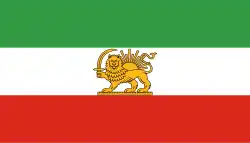
Some protesters used the Lion and Sun flag. This symbol was used on Iran's national flag before the 1979 Islamic Revolution. After the revolution, the Islamic Republic replaced it with a new emblem.[21]
The Lion and Sun flag became a symbol of opposition to the current government. Radio Free Europe/Radio Liberty described it as a symbol of national pride, secularism and defiance of theocratic rule.[21]
The flag did not have only one meaning. Some people used it to show support for the former monarchy. Others used it more generally as a symbol of resistance to the current government.[21]
The symbol was also visible in protests outside Iran. In January 2026, a protester in London replaced the Iranian embassy's national flag with the pre-1979 Lion and Sun flag.[26] In February 2026, protesters at a large rally also waved green, white and red flags with Lion and Sun emblems.[27]
Reactions
Iranian government response
Iranian officials reacted strongly to the protests. They said that people could speak about economic problems, but they also described parts of the protests as riots or unrest. Several officials connected the protests to public order, national security and foreign influence.
- Ali Khamenei, Supreme Leader of Iran, said officials should talk to protesters, but added that "rioters must be put in their place".[28]
- Chief Justice Gholam-Hossein Mohseni-Eje'i, the head of Iran's judiciary, said that the punishment for rioters would "be decisive, maximum and without any legal leniency".[29]
- Mohammad Baqer Qalibaf, Speaker of the Islamic Consultative Assembly, said that some groups wanted to turn public demands into chaos. He also said that the security of the country had to be protected.[30]
- Ahmad-Reza Radan, the chief commander of the Police Command of Iran, said: Important arrests were made of the main elements of the unrest, who will be punished after going through legal procedures.[31]
International response
The protests also led to reactions outside Iran. Foreign governments, international organizations and human rights groups criticized the way Iranian authorities responded to the protests. Many international reactions focused on human rights, the right to peaceful protest and the use of force by security forces.
- U.S. President Donald Trump warned Iran not to use deadly force against peaceful protesters. The United States also criticized the treatment of protesters and people mourning those who had been killed.[32]
- Human Rights Watch and Amnesty International said that Iranian authorities used unlawful force against protesters. They called for an end to the violence and for the protection of people taking part in peaceful protests.[33]
- The United Nations criticized Iran’s response to the protests. UN officials called on Iran to respect human rights, including the rights to peaceful assembly and freedom of expression.[34]
- Pope Leo XIV, the leader of the Catholic Church, said that he was thinking about people suffering in Iran and Syria. He called for dialogue and peace.[35][36]
Deaths, injuries and arrests
The exact number of people killed, injured and arrested during the protests is disputed. Different sources give different numbers and the numbers changed as the crackdown continued. Internet restrictions made it difficult for journalists and human rights groups to check reports from inside Iran.
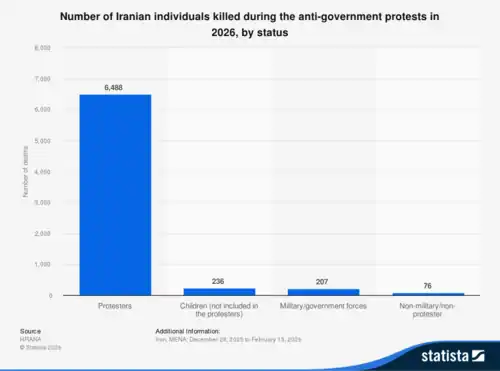
On 13 January 2026, the Associated Press (AP) reported that HRANA (Human Rights Activists in Iran) had counted at least 2,000 people killed. AP said the number became clearer after people in Iran were able to make phone calls abroad again, after days of severe communication restrictions.[37]
On 27 January 2026, the AP reported that HRANA had counted at least 6,221 deaths. HRANA said the dead included 5,858 protesters, 214 government-linked forces, 100 children and 49 civilians who were not demonstrating. AP also reported that many more people were still feared dead.[38]
Human rights groups also reported mass arrests. Human Rights Watch and Amnesty International said that Iranian security forces used unlawful force and firearms against protesters and made mass arbitrary arrests after the protests began on 28 December 2025.[39]
In February 2026, Human Rights Watch said that Iranian authorities carried out mass arbitrary detentions, torture and enforced disappearances after the crackdown. It said that the arrests were used to frighten the population after the protests.[40]
Key figures
The protests did not have one clear leader. Many demonstrations were local or were organized through social media. However, several political and government figures were important because of their role in Iran's political system, the economy, the crackdown or international reactions.
- Ali Khamenei was the Supreme Leader of Iran during the protests. He was the highest political and religious authority in the Islamic Republic and was directly criticized during the protests.[12] He was important because the protests were not only about the economy, but also about the political system that he led. He was killed in February 2026 during U.S.-Israeli strikes on Iran.[41]
- Masoud Pezeshkian is the President of Iran. His government faced pressure during the protests because of the economic crisis, the falling value of the rial and the spread of the protests.[3][42]
- Mohammad Reza Farzin was the head of the Central Bank of Iran during the start of the protests. The Central Bank became important because the protests began after the Iranian rial fell to a record low against the United States dollar. Farzin resigned after the currency crisis became a major cause of public anger.[43]
- Gholam-Hossein Mohseni-Eje'i is the head of Iran's judiciary. The judiciary became important because many protesters were arrested and some later faced criminal charges.[29]
- Ahmad-Reza Radan is the chief commander of the Police Command of Iran. The police were involved in the government response to the protests, including arrests and public order operations. Radan was important because the police played a direct role in the state response to the unrest.[44]
- Donald Trump was the President of the United States during the protests. He was important to the international reaction because he warned Iran not to use deadly force against peaceful protesters.[45]
Historical significance
The 2025-2026 protests were part of a longer history of protest in Iran after the 1979 Iranian Revolution.[46][47] Since 1979, several protest movements have challenged the Islamic Republic. These movements were not all the same, but many included anger about political power, limits on freedom, economic problems and the role of security forces.
One important earlier protest movement was the 2009 Green Movement.[48][49] It began after the disputed re-election of President Mahmoud Ahmadinejad. Many protesters believed that the election had been unfair. The protests became one of the largest challenges to the Islamic Republic since 1979.
Later protests were often linked to economic problems as well as political anger. The 2019-2020 Iranian protests began after a rise in fuel prices. They quickly became wider protests against poor living conditions, corruption and the government. Iranian authorities responded with a violent crackdown and many people were killed or arrested.[50][51]
The 2022 protests after the death of Mahsa Amini were another major turning point.[52] They were connected to women's rights, state violence and civil freedoms. The slogan "Woman, Life, Freedom" became one of the best-known slogans of that movement.[53]
The 2025-2026 protests brought together several older protest themes. Like the 2019-2020 protests, they began with anger about economic problems and living conditions. Like the 2022 protests, they also included wider criticism of the Islamic Republic and calls for political change.
References
- 1 2 3 4 5 6 "What happened at the protests in Iran?". Amnesty International. 2026-01-26. Retrieved 2026-04-12.
- 1 2 "Protests erupt in Iran over currency's plunge to record low". AP News. 2025-12-29. Retrieved 2026-01-07.
- 1 2 Parent, Deepa; Christou, William (2025-12-31). "'We want the mullahs gone': economic crisis sparks biggest protests in Iran since 2022". The Guardian. ISSN 0261-3077. Retrieved 2026-01-07.
- ↑ Kumar, Abhijeet (15 January 2026). "Who are Iran's bazaaris, and why their protests still shake the regime". Business Standard. Retrieved 12 April 2026.
{{cite web}}: CS1 maint: url-status (link) - 1 2 3 4 5 "A timeline of how the protests in Iran unfolded and the crackdown that followed". AP News. 2026-01-09. Retrieved 2026-04-12.
- ↑ Zahedi, Dariush (2008). The Social Underpinnings of Present-Day and Prerevolutionary Regimes: The Intelligentsia, the Clerics, and the Bazaaris. United States: Westview Press. pp. 84–85. ISBN 0-8133-3871-9.
- ↑ "Iran's 2025-26 protests, resilience and political containment". Elcano Royal Institute. Retrieved 2026-04-12.
- ↑ "Why Are Iranian Protesters Using the Prerevolution Lion and Sun Flag? | Meaning, 2026 Protests, & History | Britannica". Encyclopedia Britannica. Retrieved 2026-04-12.
- ↑ Glynn, Jordan (2025-12-31). "Iran Update, December 30, 2025". Institute for the Study of War. Retrieved 2026-04-12.
- ↑ "Over 12,000 feared dead after Iran protests, as video shows bodies lined up at morgue - CBS News". www.cbsnews.com. 2026-01-13. Retrieved 2026-04-12.
- ↑ "Iran: Trump warns US will intervene if Iran kills protesters". www.bbc.com. 2026-01-02. Retrieved 2026-04-12.
- 1 2 "Iran's leader says rioters 'must be put in their place' as protest death toll reaches at least 15". AP News. 2026-01-03. Retrieved 2026-04-12.
- 1 2 3 "Iran: Massacre of protesters demands global diplomatic action to signal an end to impunity". Amnesty International. 2026-01-14. Retrieved 2026-05-29.
- ↑ "Internet and phones cut in Iran as protesters heed exiled prince's call for mass demonstration". AP News. 2026-01-08. Retrieved 2026-05-29.
- 1 2 Grace, Adam (2026-01-16). "Iran Update, January 15, 2026". Institute for the Study of War. Retrieved 2026-05-29.
- 1 2 "https://x.com/IranIntl/status/2011814551600169223". X (formerly Twitter). Retrieved 2026-05-29.
{{cite web}}: External link in|title= - ↑ Humayun, Hira (2026-01-12). "A morgue overflowing with more body bags than answers amid Iran's latest crackdown on dissent". CNN. Retrieved 2026-05-29.
- 1 2 3 Human Rights Activists News Agency (February 23, 2026). "The Crimson Winter: A 50-Day Record of Iran's 2025–2026 Nationwide Protests" (PDF). HRANA. Retrieved May 29, 2026.
{{cite web}}: CS1 maint: url-status (link) - ↑ "Iran Update, January 15, 2026". Critical Threats. Retrieved 2026-05-29.
- ↑ "Several Iranian universities move classes online following student protests". www.iranintl.com. 2026-02-26. Retrieved 2026-05-29.
- 1 2 3 4 Parsa, Mani (2026-02-10). "Iranian Regime Seeks To Reclaim Lion And Sun Symbol Embraced By Protesters". Radio Free Europe/Radio Liberty. Retrieved 2026-05-19.
- ↑ "How the US-Israeli strikes on Iran unfolded and the aftermath, moment by moment". CNN. 28 February - 1 March, 2026. Retrieved 29 May, 2026.
{{cite news}}: Check date values in:|access-date=and|date=(help) - ↑ Christou, William (2025-12-30). "Iran to listen to protesters' 'legitimate demands' after widespread dissent". The Guardian. ISSN 0261-3077. Retrieved 2026-05-13.
- 1 2 3 Media, Zamaneh (2026-01-08). "An Analysis of Slogans from the First Six Days of the Nationwide Dey 1404 Protests in Iran". Medium. Retrieved 2026-05-19.
- ↑ "Lion and Sun flag", Wikipedia, 2026-05-27, retrieved 2026-05-29
- ↑ Badshah, Nadeem (2026-01-10). "Protester pulls down national flag from Iranian embassy in London". The Guardian. ISSN 0261-3077. Retrieved 2026-05-19.
- ↑ Hodina, -Stanislav; Hodina, Associated Press Stanislav; Press, Associated (2026-02-14). "Thousands demonstrate for change in Iran following deadly crackdown". PBS News. Retrieved 2026-05-19.
- ↑ Gambrell, Jon (3 January 2026). "Iran's leader says rioters 'must be put in their place'". ABC News. Associated Press. Retrieved 5 January 2026.
- 1 2 "Iran's top judge warns of no 'leniency' punishment for protesters as mosques burn". New York Post. 9 January 2026. Retrieved 10 January 2026.
- ↑ "اولین واکنش قالیباف به اعتراضات اخیر؛ دغدغه و اعتراض مردم درباره مشکل معیشتی باید با مسئولیتپذیری کامل پاسخ داده شود". خبرآنلاین. 30 December 2025.
- ↑ The main elements of the unrest were arrested last night
- ↑ Brand, Natalie (2026-01-02). "Trump says if Iran "kills peaceful protesters," the U.S. will "come to their rescue" - CBS News". www.cbsnews.com. Retrieved 2026-05-26.
- ↑ "Deaths and injuries rise amid Iran's renewed cycle of protest bloodshed". Amnesty International. 2026-01-08. Retrieved 2026-05-26.
- ↑ "Experts urge Iran to break cycle of violence, create space for dialogue". OHCHR. Retrieved 2026-05-26.
- ↑ واکنش رهبر کاتولیکهای جهان به تحولات ایران The world's Catholic leader's reaction to developments in Iran
- ↑ "Pope calls for patience and dialogue in Iran and Syria - Vatican News". www.vaticannews.va. 2026-01-11. Retrieved 2026-05-26.
- ↑ Brown, Bridget; Aboubakr, Sara; Yee, Curtis. "At least 2,000 dead in nationwide Iran protests, activists say". AP News. Retrieved 2026-05-19.
- ↑ "Activists say Iran's crackdown has killed at least 6,221 people, as the country's currency plunges". AP News. 2026-01-27. Retrieved 2026-05-19.
- ↑ "What happened at the protests in Iran?". Amnesty International. 2026-01-26. Retrieved 2026-05-19.
- ↑ "Iran: Tsunami of Arbitrary Arrests, Enforced Disappearances | Human Rights Watch". 2026-02-24. Retrieved 2026-05-19.
- ↑ "Live updates: Trump say Iran's supreme leader is dead". AP News. Retrieved 2026-05-19.
- ↑ Christou, William (2025-12-30). "Iran to listen to protesters' 'legitimate demands' after widespread dissent". The Guardian. ISSN 0261-3077. Retrieved 2026-05-19.
- ↑ "Protests erupt in Iran over currency's plunge to record low". AP News. 2025-12-29. Retrieved 2026-05-19.
- ↑ Christou, William; Parent, Deepa; Tondo, Lorenzo (2026-01-11). "Iran warns US against attack as protest death toll reportedly soars". The Guardian. ISSN 0261-3077. Retrieved 2026-05-19.
- ↑ Brand, Natalie (2026-01-02). "Trump says if Iran "kills peaceful protesters," the U.S. will "come to their rescue" - CBS News". www.cbsnews.com. Retrieved 2026-05-19.
- ↑ "IRAN ii. IRANIAN HISTORY (2) Islamic period (page 6)". Encyclopaedia Iranica. Retrieved 2026-05-26.
- ↑ Anderson, Betty S. (2015). A history of the modern Middle East: rulers, rebels, and rogues. Stanford, California: Stanford University Press. pp. p. 357. ISBN 978-0-8047-8324-8.
{{cite book}}:|pages=has extra text (help) - ↑ "The Green Movement | The Iran Primer". iranprimer.usip.org. 2010-10-06. Archived from the original on 2022-11-30. Retrieved 2026-05-26.
- ↑ Anderson, Betty S. (2016). A history of the modern Middle East: rulers, rebels, and rogues. Stanford, California: Stanford University Press. pp. p. 447. ISBN 978-0-8047-8324-8.
{{cite book}}:|pages=has extra text (help) - ↑ "Iran: No Justice for Bloody 2019 Crackdown | Human Rights Watch". 2020-11-17. Retrieved 2026-05-26.
- ↑ Shutdown, Iran Internet. "A web of impunity: The killings Iran's internet shutdown hid — Amnesty International". Retrieved 2026-05-26.
- ↑ "Iran is responsible for the 'physical violence' that killed Mahsa Amini in 2022, UN probe finds". AP News. 2024-03-08. Retrieved 2026-05-26.
- ↑ "Justice and accountability: Woman, Life, Freedom protests". OHCHR. Retrieved 2026-05-26.