Ōharae-shiki
| Ritual ceremonies of the Imperial Palace |
| Shihohai・Saiten-sai |
| Genshi-sai |
| Start of Musical Performance |
| Emperor Showa Festival (Previous Emperor's Festival) |
| Emperor Kōmei festival[a] |
| Prayer for Good Harvest |
| The Emperor's Birthday |
| Spring Kōreisai・Spring Shrine Festival |
| Jimmu Festival・Kōrei-den Kagura |
| Empress Kōjun festival[a] |
| Yoori・Oharae |
| Emperor Meiji festival[a] |
| Autumn Imperial Spirit Festival (秋季皇霊祭)・Autumn Shrine Festival (秋季神殿祭) |
| Kannamu-sai |
| Niiname-no-Matsuri |
| Kashiko dokoro Sacred Kagura |
| Emperor Taishō festival[a] |
| Yoori・Oharae |
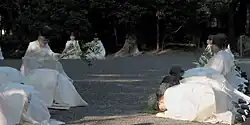
The Ōharae-shiki (大祓式) is a Shinto purification ritual. It is in a group of purification rituals called harae. The Japanese name means "Great Purification".[1] It is also called the Nakatomi no harae (中臣の祓). People say the Ōharae no Kotoba prayer during the ritual.
The ritual is performed twice a year on June 30[2] and December 30[3] at several shrines. It is also done by people to repent for sins. People also do it at the Daijosai, and when an unmarried prince or princess visits Ise Grand Shrine or the Kamo Shrines.[1][4]: 7 People sometimes do the December 30 ritual on New Year's Eve instead.[5]
References
- 1 2 Namiki, Kazuko. "Ōharae". Kokugakuin University Encyclopedia of Shinto. Retrieved 9 November 2023.
- ↑ "Nagoshi no Oharae Purification Ritual". Kamo Wakeikazuchi Jinja Shrine (Kamigamo Jinja) (in Japanese). Retrieved 2023-06-05.
- ↑ Meador, Spencer (2017-07-04). "Oharae". Sanpai Japan. Archived from the original on 2023-06-05. Retrieved 2023-06-05.
- ↑ Hardacre, Helen (2016-11-11). Shinto: A History (Illustrated ed.). New York (N.Y.): Oxford University Press. ISBN 978-0-19-062171-1.
- ↑ "Shiwasu Oharae-shiki (Great Purification Ceremony in December) | Samukawa-jinja Shrine". Samukawa-jinja Shrine Official Website. Retrieved 2023-06-05.